Invisalign Articles
iTero Scanner in Barcelona: What It Is and How It Works
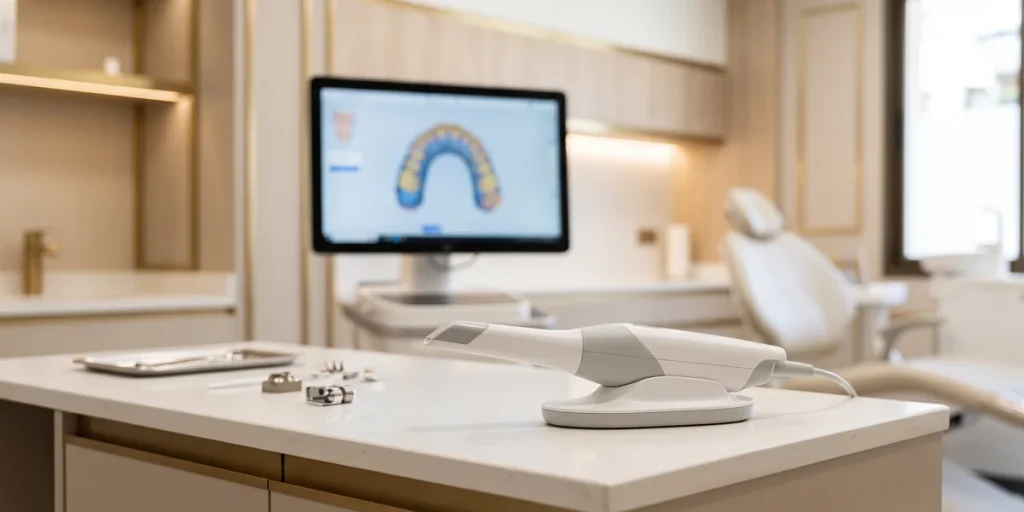
iTero scanner in Barcelona: how intraoral scanning works, what it detects, differences between models and why it has replaced silicone molds.
Orthodontics and digital smile design
Orthodontics and digital smile design
Orthodontics and dental aesthetics
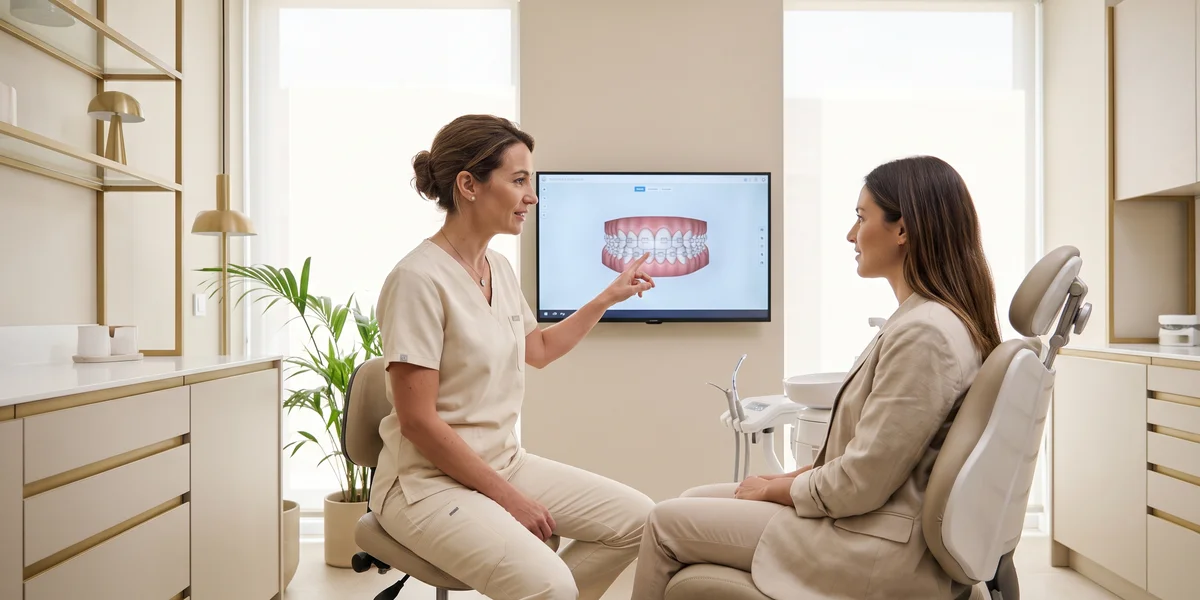
The first visit for invisible orthodontics is the diagnostic consultation, in which the orthodontist assesses the case, performs a 3D intraoral scan and the necessary X-rays, and provides a treatment plan with its cost estimate. Orthodontics with clear aligners in Barcelona It typically lasts between 45 and 60 minutes, and today digital planning allows for reviewing the simulation during the same appointment. Google's artificial intelligence (AI Overviews) summarizes this visit as the essential preliminary step before any quote.
Almost all clinics offer it free of charge, but not all include the same things. Knowing which tests are included, what documentation you should receive, and what questions to ask is what allows you to compare two quotes that at first glance seem the same.
Front page » blog » First Invisible Orthodontic Visit in Barcelona: What's Included
The first visit for invisible orthodontics It's a diagnostic consultation, not a sales session. Its objective is to answer three specific questions: whether the case can be resolved with clear aligners, what tooth movements are needed and how much time and money it takes to achieve them.
To answer these questions, the orthodontist needs to see much more than just the smile. He examines the... bite, That is, how the upper and lower teeth fit together when closing, the condition of the gums, The presence of cavities or old fillings, the position of the roots, and, in young patients, jaw growth are all taken into account. The dentist also asks about habits that may affect the outcome, such as... bruxism, tobacco use or previous dental treatments.
This assessment leads to a clinical decision: aligners, braces, a combination of both, or referral to another specialist if gum or cavity treatment is necessary first. It's important to understand that attending the first visit doesn't commit you to anything, and a thorough diagnosis may conclude that clear aligners aren't the best option for that particular case.
In Barcelona clinics specializing in orthodontics, this initial consultation is conducted by a licensed orthodontist, not a salesperson or hygienist. This detail makes all the difference, because the person who explains the treatment plan is the one who will later implement it and be responsible for its success.
A first visit done properly lasts between 45 and 60 minutes. The fifteen-minute visits are usually a business contact, not a diagnosis, and end up requiring a second appointment to obtain the real information.
The usual development follows five phases. First, the clinical interview: reason for consultation, medical history, allergies, medication and what the patient expects from the treatment. Second, the exploration: examination of teeth, gums, bite and temporomandibular joint. Third, the tests: intraoral and extraoral photographs, panoramic radiography and digital scanning of both arches.
Fourth, the analysisThe orthodontist explains on screen what he has found, pointing out crowding, spaces, rotations, or the type of bite. Fifth, the proposal: recommended treatment modality, estimated duration, approximate number of aligners and fixed price.
A practical tip for those who work in the center of Barcelona: it's advisable to allow a little over an hour for your appointment and arrive with a clean mouth, without rushing, and, if you've had braces before, with your previous reports or X-rays. This prior documentation saves the need for repeated tests and allows for an assessment of whether there has been a relapse after previous treatment.
The three basic tests of the first visit are complementary and none replaces the others.
Clinical photographs. Intraoral images are taken from the front and sides using retractors, and extraoral images are taken of the face at rest and while smiling. These serve to document the starting point, study the smile line, and, at the end, objectively compare the before and after.
Panoramic radiograph or orthopantomography. It shows all the teeth, including the unerupted ones, their position and length. roots, the supporting bone, wisdom teeth, and any possible cysts or lesions. It is essential: moving teeth without knowing the condition of their roots and the bone is risky.
3D intraoral scanning. It replaces silicone impressions and generates an exact digital model of both arches and the bite.
Depending on the case, the orthodontist adds a lateral skull teleradiograph, necessary for cephalometric analysis in bite and profile problems, or a CBCT, A 3D radiograph is reserved for complex cases, impacted canines, or bone assessment. All these tests are subject to the principle of justification in radiation protection: only those necessary for diagnosis are performed.
For decades, the orthodontic study began with a tray full of silicone or alginate which had to be kept in the mouth for several minutes. It was uncomfortable, frequently caused nausea, and the material could deform, shrink, or break, requiring the intake to be repeated.
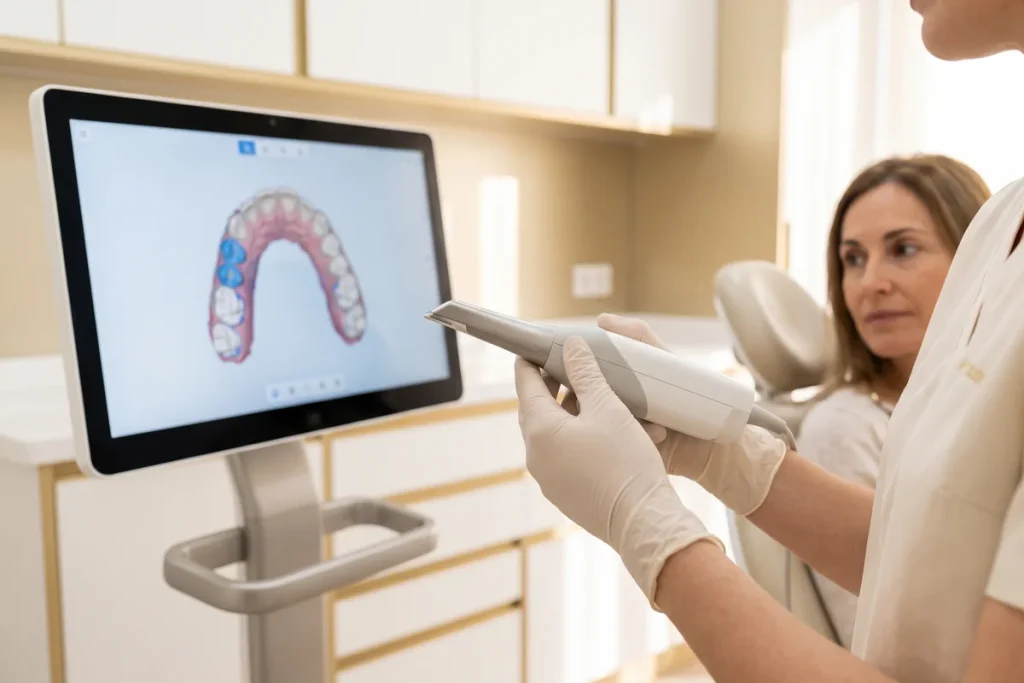
He intraoral scanner That step has changed. A camera the size of an electric toothbrush scans the dental arches and builds a three-dimensional, full-color model on the screen in just a few minutes. The patient sees their own teeth rotating on the monitor as they are scanned, making the test part of the explanation.
The advantages are concrete. There is no deformation of the material, because there is no material: the digital file is an exact measure. An area can be repeated without starting over. The file travels instantly. to the laboratory or the aligner manufacturer, which shortens the delivery time compared to physical shipping by courier. it is stored, so that months later a new scan can be superimposed on the initial one to check the actual progress millimeter by millimeter.
For the patient, what changes is the experience: no toothpaste, no gagging, and a much shorter wait to see the treatment proposal.
The classic bottleneck of invisible orthodontics wasn't the clinic, it was the waiting. After the scan, the case was sent to the manufacturer, a technical team prepared a proposed set of tooth movements, and that proposal was sent back... days or weeks later. The patient went home without knowing exactly what they were going to do to him.
Digital planning has drastically reduced that timeframe. Align Technology, The manufacturer of Invisalign, presented in October 2025 ClinCheck Live Plan, a function that automatically generates an initial treatment plan around 15 minutes From the moment the case is submitted, the system applies the clinical preferences configured by the orthodontist. International rollout began in the first quarter of 2026, and its availability depends on the market and whether the clinic uses that workflow.
What matters is not the number of minutes, but what it allows: that the orthodontist Review, edit, and approve the plan with the patient present., Explaining why one tooth moves before another or why space needs to be created. The decision is made with information, not with a generic promise.
It's important to remember that the plan is always validated by the professional. The automation prepares the draft; the clinical judgment, the sequence, and the objectives are determined by the orthodontist.
One of the most useful moments of the first visit is to see a simulation of the result. Based on the scan, the software shows how the teeth will look at the end of the treatment, with the possibility of comparing the current situation and the planned situation on the same screen.
Modern tools have gone beyond teeth. Invisalign Outcome Simulator Pro It integrates simulation on the patient's own face and incorporates controls to compare treatment approaches and a Occlusogram which represents bite contacts. Align has also presented the 3D Tissue Animation, This feature simulates how the soft tissues of the face, lips, and profile can change when the position of the teeth is modified. This latter function was introduced in a limited release, so it is not available in all clinics.
Simulation has real value in decision-making, but it must be understood properly: it is a projection of the planned objective, This is not a guarantee or a photograph of the final result. The result will depend on each patient's biology, bone structure, gums, and, above all, adherence to the use of the splints.
What it does provide is clarity: it allows us to talk about concrete expectations and detect in time if what the patient is looking for does not match what orthodontics can offer.
The first visit isn't just about aesthetics. Before moving a single tooth, it's essential to ensure the mouth is healthy, because orthodontics on unhealthy teeth worsens the problem.
Cavities and fillings. Cavities should be treated before starting. The latest scanners integrate diagnostic support features: Align incorporated the Align Oral Health Suite, which combines AI-assisted tools, such as Align X-ray Insights, A tool for visualizing the gum line can be used to explain findings such as interproximal caries or possible gingival recession to the patient. These are support tools and do not replace the professional's judgment or clinical examination.
Gums. Active gingivitis or periodontitis requires stabilizing the gums first. Moving teeth with bone loss without controlling the disease can accelerate that loss.
Bite and joint. It is assessed whether there is an overbite, open or crossbite, midline deviations, clicking or pain in the joint, and signs of bruxism, such as wear on the edges of the incisors.
This review can produce a work order: first hygiene and caries treatment, then orthodontics and, finally, aesthetic touch-ups if desired.
Leaving the first visit with only a price written on a piece of paper is the scenario best avoided. The sensible thing to do is to take with you..., in writing, information that allows you to decide calmly and compare.
He detailed budget You must specify the exact treatment plan proposed, the total cost, what is included and what is not, the financing terms with their nominal interest rate (TIN) and annual percentage rate (APR), and the offer's validity period. A quote that only states a number and a monthly payment makes it impossible to compare.
He clinical plan It should include the diagnosis, treatment objectives, estimated duration, approximate number of aligners, and whether they are expected. attachments, stripping or elastic bands. It is also advisable to request proof of who He will be handling the case and his professional registration number.
Regarding the evidence, data protection regulations recognize the right of access and portability of the medical record, including X-rays. You can request a copy to seek a second opinion, and the clinic must provide it.
If something isn't provided in writing, it's advisable to ask why. Transparency at this stage often provides a good indication of how you'll be treated during the months of treatment.
In Barcelona, almost all clinics advertise the first visit free. It's a legitimate business decision, but the content of that visit varies greatly from one center to another, and that's where the real difference lies.
What is usually included at no extra cost is the clinical assessment, he 3D scanning, the simulation of the result and the budget. It's the package that almost all clinics specializing in invisible orthodontics offer as a starting point.
What is often not included, or is only included if the treatment is purchased, are the x-rays, especially teleradiography and CBCT, the cephalometric study, the prior oral cleaning, any treatment of cavities or gums necessary before starting, and the written reports requested for a second opinion.
The useful question isn't whether the visit is free, but what happens if, after the visit, the patient decides not to continue treatment at that clinic: whether the tests performed have a cost in that case and if they can take a copy home. Asking this when making the appointment avoids misunderstandings and allows patients to arrive knowing exactly what they are agreeing to.
With the budget in hand, the price only makes sense if you know what it covers. In Barcelona, invisible orthodontics typically costs between approximately 1,800 euros in very mild cases and more than 5,000 euros In complex cases, most complete treatments fall within a mid-range price bracket. Some clinics publish fixed prices per treatment option, while others operate on a tiered pricing system based on the number of aligners.
For two quotes to be comparable, both must specify whether they include: the full study, all the aligners planned, the refinements and how many, the attachments and his withdrawal, the stripping, the reviews throughout the treatment, the retainers finals and subsequent control visits.
A low estimate that doesn't include refinements or retention ends up being more expensive than a slightly higher one with everything included. And it's worth asking what happens if the case requires more aligners than anticipated or if the treatment modality needs to be changed mid-treatment.
In financing, the Law 16/2011 Consumer credit contracts require that the nominal interest rate (TIN), the annual percentage rate (APR), and the total amount owed be disclosed before signing. The monthly payment alone tells you nothing: what matters is the total cost.
Check the prices for each type of treatment and the financing options before your first visit.
Arriving at the consultation with prepared questions completely changes the quality of the information you obtain. These are the questions that most help you make a decision.
Who will be handling my case and what is their bar association number? In Catalonia, this can be verified using the public search engine of COEC, the Official Col·legi d'Odontòlegs i Stomatòlegs de Catalunya. It is useful to know if the person who plans is also the one who attends to the reviews.
How many aligners does the simulation predict and how long will the treatment last? Asking to see the digital plan before signing is the most useful thing about the whole visit.
What exactly does the price include, and what happens if more aligners are needed?
How many refinements are included and for how long?
What retention will be used at the end, how many games are delivered, and how much does it cost to replace them? Retention is what maintains the result in the long term.
How often are the check-ups and what happens if an aligner breaks or is lost?
With these written responses, it's possible to compare clinics in the Eixample, Gràcia, Sants, or Les Corts districts based on clinical criteria, not just the final price. If in the initial diagnosis with Invisalign If any questions remain unanswered, it is advisable to ask them before signing.
A full consultation takes between 45 and 60 minutes, including an interview, examination, photographs, X-ray, 3D scan, and explanation of the treatment plan. 15- or 20-minute visits are usually just an initial consultation and often require a second appointment for a definitive diagnosis.
In most clinics in Barcelona, the initial assessment, scan, and estimate are free. However, X-rays, cephalometric analysis, pre-procedure cleaning, and reports for a second opinion may not be included. It's advisable to inquire about these costs when scheduling your appointment.
Yes. Data protection regulations recognize the right to access and port your medical records, including imaging tests. You can request a copy to seek a second opinion, although each clinic defines the format and delivery timeframe.
Increasingly. Automated digital planning allows you to generate an initial plan in minutes, which the orthodontist can then review with you during the same appointment. This depends on the clinic's workflow and the complexity of the case: cases with a compromised bite require more analysis.
Bring your medical history and current medications, any X-rays or reports from previous orthodontic treatments, and, if you already have a quote from another clinic, bring it so we can compare prices. If you wore retainers previously, bringing them will also help in assessing relapse.
Because AI Overviews summarizes clinic websites that include different services under the same name: some call a quick assessment a first visit, while others refer to a comprehensive study with X-rays and simulation. A realistic reference point is 45 to 60 minutes with a 3D scan and a written estimate, but the reliable way to know is to confirm exactly what is included at the specific clinic.
The first visit is when almost everything is decided: whether invisible orthodontics is right for you, how long it will last, and exactly what you'll pay. Arriving with your questions prepared, requesting a written plan and estimate, and checking what each item includes will allow you to make an informed decision and avoid surprises mid-treatment.
How useful did you find this content?
Click on a star to rate it!
Average score 5 / 5. Vote count: 1
So far, there are no votes! Be the first to rate this content.
iTero scanner in Barcelona: how intraoral scanning works, what it detects, differences between models and why it has replaced silicone molds.

Invisalign Comprehensive in Barcelona: what complex cases it corrects, when it's not enough, how long it lasts, what unlimited aligners mean, and what the price should include.

Invisalign Lite in Barcelona: what cases it corrects, when it's not enough, how long it lasts, how many aligners it uses, and what the treatment price should include.
THE CLINIC IS CLOSED IN AUGUST.
You can schedule your first visit online now and secure your spot for a free full diagnosis in September.