🎯 CURRENT RATES ⏰ Valid until July 16 📅 Book TODAY and lock in the price!     🎯 CURRENT RATES ⏰ Valid until July 16 📅 Book TODAY and lock in the price!     🎯 CURRENT RATES ⏰ Valid until July 16 📅 Book TODAY and lock in the price!

Orthodontics and digital smile design

Orthodontics and digital smile design

Orthodontics and dental aesthetics

Smiling man putting on an Invisalign Comprehensive clear aligner at a dental clinic in Barcelona

Invisalign Comprehensive in Barcelona: Cases, Price and Duration

What you will learn in this guide

  • What complex cases does he/she deal with? Which ones are Invisalign Comprehensive and which ones are not.
  • How long does it last? And what does it mean to have unlimited aligners?.
  • Why do prices in Barcelona vary so much? and what it should include.
  • How is it decided? between Comprehensive, Moderate, Lite or brackets.

Invisalign Comprehensive is the most complete version of the Invisalign system, formerly called Invisalign Full, designed for bite problems, severe crowding, and complex malocclusions. Among the Invisalign aligners in Barcelona It's the only option with no limit on the number of aligners during the package period, typically lasts 12 to 24 months, and costs between €2,900 and €5,500. It's the option that Google's AI Overviews associates with complex cases treated by an orthodontist.

Choosing comprehensive care isn't about wanting the most expensive treatment, but rather about what the diagnosis reveals. This guide explains what it corrects, when it falls short, how its duration is calculated, and what items should be included in the estimate to compare clinics effectively.

Content

What is Invisalign Comprehensive and why was it previously called Invisalign Full

Invisalign Comprehensive It is the complete treatment modality of Align Technology, the company that manufactures Invisalign. For years it was marketed as Invisalign Full Later, Align reorganized its catalog and renamed it Comprehensive. That's why many clinics in Barcelona still use both names: it's the same treatment, with the same benefits.

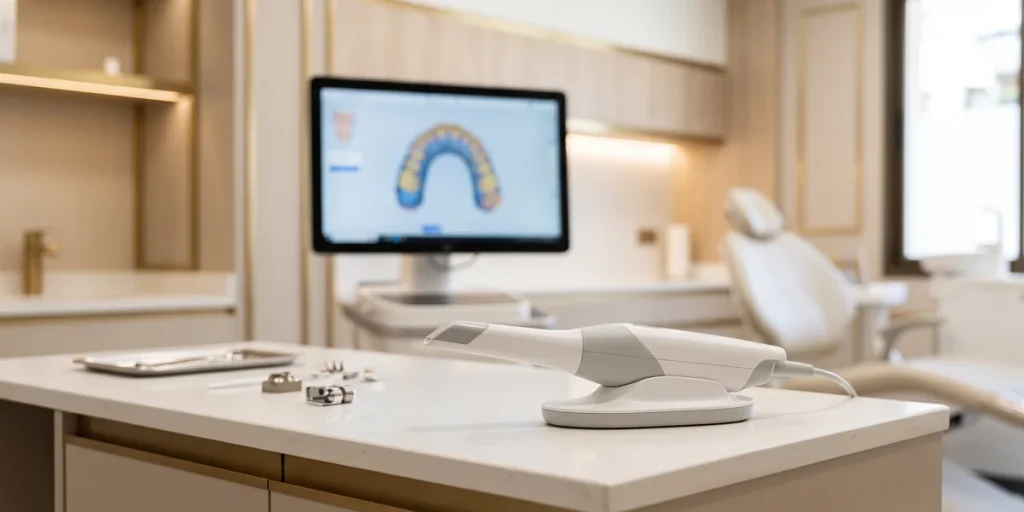
Its main feature is that It does not have a maximum number of aligners within the package period. This allows for planning long and complex moves in ClinCheck, Use the digital planning software and add as many adjustment phases as the case requires. SmartTrack, the intraoral scan iTero and all the system tools: attachments, precision cuts for elastics and expansion protocols.

The other options, such as Express, Lite, or Moderate, limit the number of splints and, therefore, the type of movement that can be performed. Comprehensive is reserved for cases where correction is needed. relationship between jaws, It's not just the position of the teeth. In practice, it's the format orthodontists use to treat with aligners what was previously only possible with braces.

Cases treated: overbite, open bite, crossbite, and Class II and III malocclusions

The main reason for choosing Invisalign Comprehensive is the presence of a bite problem, That is, an incorrect relationship between the upper and lower teeth. These are cases that don't fit into a short format because they require long, coordinated movements in both arches.

Deep overbite. The upper incisors excessively overlap the lower incisors. This is corrected by intruding the anterior teeth and often by leveling the curve of the lower arch, a process that requires several steps.

Open bite. The front teeth don't touch when the mouth is closed. Aligners have an advantage here because the splint itself acts as a block that helps to intrude the molars.

Crossbite. One or more upper teeth are positioned inside the lower teeth, either in the front or on the sides. This is treated with expansion and individual tooth movement.

Class II and Class III. In Class II malocclusion, the lower arch is positioned behind the upper arch; in Class III, the opposite occurs. When the malocclusion is of dental or moderate origin, Comprehensive corrects it by combining aligners with intermaxillary elastics for several months.

In all these cases, the diagnosis must include X-rays and a bite analysis, not just a scan. This is what allows us to distinguish between a dental problem, treatable with aligners, and a skeletal one.

Severe crowding and arch expansion with aligners

When the lack of space in the arch exceeds 4 or 5 millimeters, it is referred to as moderate or severe crowding. The teeth overlap, there are marked rotations, and the canines are outside the alignment. This is another typical profile for Invisalign Comprehensive.

To gain space, the orthodontist can combine several strategies in the treatment plan. The first is... arch expansion: to widen the upper or lower dental arch in a controlled manner by tilting the back teeth outwards. In adults, this expansion is dental and has limits, so it is carefully planned to avoid compromising the gums.

The second one is the distalization, This involves sequentially moving the molars backward to create space in front. With aligners, this movement is very predictable but slow, which is one of the reasons why Comprehensive cases easily exceed 30 or 40 aligners.

The third one is the stripping or interproximal reduction, which removes tenths of a millimeter of enamel between teeth. And, in extreme cases, the following may be considered: premolar extraction, This can also be managed with Comprehensive, although it requires more control and an experienced orthodontist.

The chosen combination is shown in the simulation before starting, allowing the patient to understand how the space will be created and how long it will take.

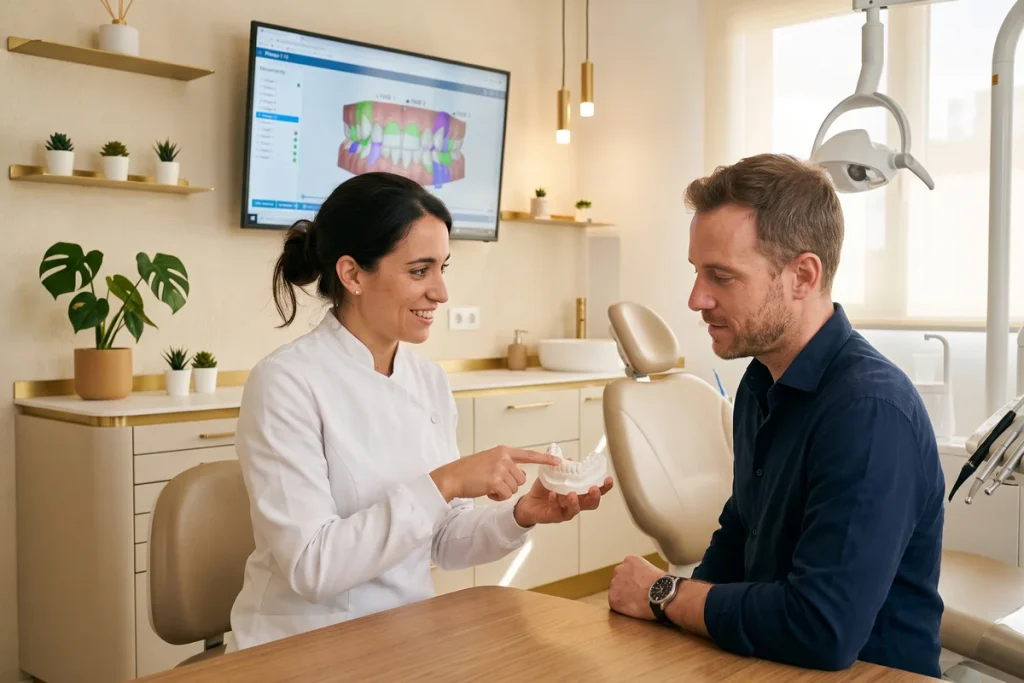
Orthodontist explaining a 3D dental model and digital treatment planning to a patient in Invisalign Comprehensive

When Comprehensive is not enough: orthognathic surgery and skeletal cases

Invisalign Comprehensive greatly expands what can be done with aligners, but it doesn't replace all treatments. There are situations where neither aligners nor braces alone are sufficient.

The clearest one is the severe skeletal discrepancy In adults: significantly retruded or protruding jaws, marked facial asymmetries, or open bites of skeletal origin. In these cases, simply moving the teeth compensates for the problem but does not correct it, and the result may be unstable or aesthetically unappealing. The solution usually involves orthognathic surgery, planned together with a maxillofacial surgeon, with orthodontics before and after the procedure.

Invisalign has specific protocols to complement surgery, so the aligners can still be an option for the orthodontic phase. However, they cannot replace skeletal correction.

Patients with [the following conditions] are also excluded or require prior treatment. active periodontal disease, Significant bone loss or very short roots are not recommended, as moving teeth on weakened support is risky. First, the gums are stabilized, and then the treatment is evaluated.

Finally, Comprehensive requires constancyIf the patient cannot wear the splints for more than 20 hours a day for more than a year, a fixed appliance may be more reliable for a complex case.

How long does Invisalign Comprehensive treatment last?

An Invisalign Comprehensive treatment lasts, in most cases, between 12 and 24 months. More complex cases, with long distalizations or extractions, may take somewhat longer. The exact number is determined by the simulation in ClinCheck, which indicates how many steps each movement requires.

The calculation is based on the number of aligners. A typical Comprehensive case may require between 30 and 60 splints in the initial series. With changes every 7 to 14 days, that means between 7 and 20 months of active phase. To that figure are added the refinement phases, common in complex cases, and the scanning and manufacturing time for each new series, which is around 2 to 4 weeks.

There are three factors that most frequently prolong treatment. The first is insufficient use of the aligners, under 20 to 22 hours daily. The second, not wearing the elastic The third is missing checkups, which prevents the timely detection of a tooth that is not following the plan.

To compare these timeframes with those of other formats, it's worth examining how the duration changes according to complexity and how long retention needs to be maintained afterward. A well-resolved complex case requires, at a minimum, the same level of retention as during treatment.

What does unlimited aligners mean and how many refinements does it include?

The expression unlimited aligners This is one of the most frequently repeated marketing arguments in Barcelona, and it's important to understand it properly. It means that, within the period covered by the Comprehensive package, the clinic can order all the sets of splints the case requires from Align without any change in the laboratory cost.

In practice, that covers two things. On the one hand, the initial series, with the number of aligners specified in the treatment plan, whether it's 30 or 70. On the other hand, the refinementsWhen a series is finished, the orthodontist scans again, compares the actual result with the simulation, and orders adjustment aligners for the teeth that have not reached their position.

This doesn't mean the treatment is unlimited in time, nor that any budget will cover everything. The Align package has a validity period And after that period, new aligners are not free. Furthermore, each clinic decides whether or not its price includes refinements, check-ups, and retainers.

Therefore, during the first visit, it's advisable to ask how many refinements are included in the price, for how long, and what happens if that period is exceeded due to circumstances beyond the patient's control or lack of cooperation. Having this in writing prevents misunderstandings midway through a treatment that can last two years.

Elastics, attachments and stripping: the tools of a complex case

Complex cases cannot be resolved with aligners alone. Invisalign Comprehensive uses several auxiliary resources that should be understood before starting treatment, as they affect the patient's daily life.

Attachments. These are small, tooth-colored composite reliefs that are bonded to the enamel. They provide the splint with a point of support for rotating, tilting, extruding, or intruding teeth. In a comprehensive treatment, it is common to have attachments on many teeth, and these are removed at the end without damaging the enamel.

Intermaxillary elastics. Small elastic bands that hook into precision cuts on the aligners or onto buttons bonded to the teeth, connecting the upper and lower arches. They are the primary tool for correcting malocclusion. Classes II and III and certain crossbites. They are worn almost all day and are changed daily.

Stripping. Interproximal polishing of between 0.1 and 0.5 millimeters per contact to gain space in crowded teeth. It is painless and is programmed at the exact stage when it is needed.

Buttons and auxiliary functions. In some difficult moves, special buttons or sequences are added, always planned in ClinCheck.

The use of elastics, along with splints, is the most crucial factor in the success of a complex case. Without them, the bite will not be corrected even if the teeth are aligned.

The price of Invisalign Comprehensive in Barcelona and why it varies so much

In Barcelona, the price of Invisalign Comprehensive ranges approximately between 2,900 and 5,500 euros, With occasional promotions at the lower end of the price range and very complex cases that may exceed the higher end. This is the option with the most variation between clinics, and not because of the cost of the splints, which is similar for all.

The difference lies in what each budget includes. Before comparing, it's advisable to check that the price includes the initial study with scanning, x-rays and ClinCheck, all aligners and package refinements, the attachments and his withdrawal, the stripping, the elastic, the reviews throughout the treatment and the retainers final, fixed or removable type Vivera. It also depends on who plans the case: an orthodontist with a high volume of complex cases usually needs fewer refinements.

Some clinics indicate that extremely complex cases may exceed their reference price. This is reasonable, but it's advisable to request a final written estimate after reviewing the simulation, not before.

The most common form of payment is financing in installments, subject to the Law 16/2011 of consumer credit contracts, which requires informing of the nominal interest rate (TIN), the annual percentage rate (APR), and the total cost before signing.

Do you want to know how much your case would cost with Invisalign Comprehensive?

Check the prices for each type of treatment and the financing options before your first visit.

View prices for invisible orthodontics in Barcelona

Comprehensive versus Lite and Moderate: how the modality is decided

Align offers several options, and the choice depends not on patient preference or available budget, but on the complexity of the case which shows the digital planning.

Invisalign Lite It works with up to 14 aligners and addresses mild crowding, small diastemas, and relapses after previous orthodontic treatment. It is the short format for mild cases, with a typical duration of 6 to 9 months.

Invisalign Moderate It extends the limit to about 20 aligners and accommodates moderate malocclusions, with a little more room to correct the bite.

Invisalign Comprehensive, With no limit on the number of aligners in the package, it is the right choice when you need to correct the relationship between jaws, create a lot of space, or coordinate long movements in both arches.

The reasonable professional approach is to first plan the entire case in ClinCheck and determine how many stages are needed. If the simulation can be successfully completed in 14 aligners, the Lite plan is sufficient; if around 20 are needed, Moderate is the best option; and if more than 20 are required or if elastics are needed to correct the bite, Comprehensive is the appropriate choice.

Choosing a lower-priced option often ends up being more expensive: the case is left unfinished, the package needs to be upgraded, and the total cost ends up exceeding that of the complete treatment. Choosing Comprehensive for a mild case, on the other hand, means paying for a capacity that won't be used.

Invisalign Comprehensive versus braces in complex cases

For years, complex cases were almost always treated with braces. Today, with Invisalign Comprehensive, many orthodontists in Barcelona resolve them with aligners, although each system has its strengths.

Aesthetics and comfort. The aligners are virtually invisible, don't cause chafing, and are removed for eating. In 18- or 24-month treatments, that difference is significant for adults with public or professional exposure.

Hygiene. With aligners, brushing and flossing are normal, which reduces the risk of cavities and gingivitis during long-term treatment. With braces, hygiene is more difficult and requires interdental brushes.

Movement control. Braces remain highly effective for certain specific movements, such as difficult extrusions or extreme rotations of rounded teeth. With Comprehensive orthodontics, these movements are addressed with attachments and refinements, and the outcome depends heavily on the orthodontist's experience.

Collaboration. That's the big difference. Braces work 24 hours a day without depending on the patient; aligners only work if worn for more than 20 hours a day and if elastics are used.

Visits. With aligners, check-ups are spaced every 6 to 10 weeks; with braces, they are usually monthly.

In summary, for a consistent adult with a complex case of dental origin, Comprehensive offers comparable results with greater comfort.

What to ask before starting a comprehensive treatment

Comprehensive treatment is a decision that takes one or two years and costs several thousand euros, so it's worth arriving at your first appointment with clear questions. These are the questions that will help you compare clinics effectively.

Who plans and oversees the case? A complex case should be handled by a registered orthodontist. In Catalonia, you can check using the search engine of [website/website name]. COEC, the Official Col·legi d'Odontòlegs i Stomatòlegs de Catalunya.

What diagnostic tests are performed? In addition to iTero scanning, a bite case requires panoramic radiography and lateral cephalometric radiography, and sometimes a CBCT.

How many aligners and how long does the simulation predict? Asking to see the ClinCheck before signing is the most helpful way to understand the plan.

What does the price include? Refinements, attachments, elastics, revisions, retainers, and for how long.

What happens if the case gets complicated? If it becomes necessary to extend the deadline, change the strategy, or refer for surgery, what is the cost?

What retention will be used upon termination? Retainer type, number of sets, and replacement price.

With these written responses, it is easy to compare clinics in Eixample, Gràcia, Sarrià or Les Corts on equal terms and choose based on clinical criteria and not just the final figure.

Frequently asked questions about Invisalign Comprehensive in Barcelona

There is no maximum number of aligners required within the package period. The initial series typically ranges from 30 to 60 aligners, depending on the case, and further refinements are added as needed. The exact number is determined by the simulation in ClinCheck, so it's advisable to request a review of it before starting.

Yes. Invisalign Full was the previous name for the complete treatment, and Align Technology renamed it Comprehensive when they reorganized their product catalog. The benefits are the same, which is why some clinics in Barcelona still use both names.

Yes, when the problem is mild to moderate dental or skeletal. Overbites, open bites, crossbites, and many Class II and III malocclusions are corrected by combining aligners with intermaxillary elastics. If the skeletal discrepancy is severe, the orthodontist will assess the need for orthognathic surgery in conjunction with a maxillofacial surgeon.

Refinements are added to finalize the case. If it remains within the package's validity period, additional aligners are free of charge, but each clinic sets its own terms and conditions regarding revisions and extensions. It is advisable to request these in writing before signing.

Yes. Most clinics in Barcelona offer payment plans through consumer credit institutions, with terms typically ranging from 12 to 60 months. By law, they must disclose the nominal interest rate (TIN), the annual percentage rate (APR), and the total amount before signing, so it's advisable to compare the total financed cost.

Because Google's artificial intelligence summarizes clinic pages that include different concepts: some advertise promotional prices without retainers or checkups, while others show the total financed amount with everything included. A realistic reference point is between €2,900 and €5,500, but the reliable figure is the one in the written estimate after reviewing your simulation.

Invisalign Comprehensive allows for the treatment of cases with aligners that, until recently, could only be addressed with braces, provided the diagnosis confirms the problem is dental and the patient can commit to daily use of aligners and elastics. Comparing quotes based on what's included and requesting to see a simulation before signing is the best way to choose the right treatment of this scope.

How useful did you find this content?

Click on a star to rate it!

Average score 5 / 5. Vote count: 1

So far, there are no votes! Be the first to rate this content.

Further News

THE CLINIC IS CLOSED IN AUGUST.

You can schedule your first visit online now and secure your spot for a free full diagnosis in September.

Call Now Button