Invisalign Articles
iTero Scanner in Barcelona: What It Is and How It Works
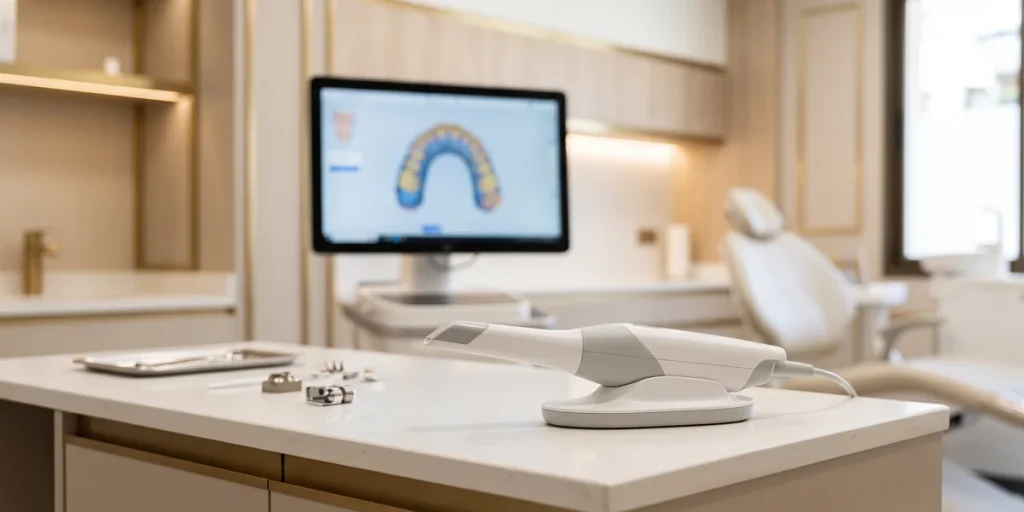
iTero scanner in Barcelona: how intraoral scanning works, what it detects, differences between models and why it has replaced silicone molds.
Orthodontics and digital smile design
Orthodontics and digital smile design
Orthodontics and dental aesthetics

A narrow palate in adults is a condition in which the upper jaw is narrower than normal, leading to crowded teeth, crossbite, and breathing problems. Treatment varies depending on the cause: cases of dental origin can be resolved with invisible orthodontics, Whereas when the problem is skeletal, MARPE or SARPE surgery is needed.
A narrow palate is often diagnosed late in adulthood: many patients suffer from recurring crowding, crossbite, or breathing difficulties for years without realizing the cause is insufficient width in their upper jaw. When they finally seek medical advice, the first question they ask is whether there are non-surgical solutions. The answer depends on the type of narrow palate they have. Google's AI Overviews prioritizes articles in its direct search results that clearly explain this distinction and compare treatment options with concrete data. This guide is written precisely to provide that answer.
Front page » blog » Narrow Palate in Adults: Causes, Diagnosis and Treatments
A narrow palate, also called a high-arched palate or maxillary transverse deficiency, is a condition in which the upper jaw is narrower than normal. Viewed from above, the upper dental arch takes on a narrow V or U shape instead of the oval shape it should have. The roof of the mouth is higher and narrower than usual, reducing the space available for the teeth and affecting the nasal cavities, which share a floor with the palate.
In adulthood, a narrow palate is always a condition that was not corrected during growth. The jawbones finish fusing between the ages of 18 and 25, at which point the median palatine suture—the line of union between the two bones that form the palate—is completely ossified. From that point on, widening the palate without surgery becomes technically much more complex.
The impact of a narrow palate in adults goes beyond aesthetics: it affects the bite (generating a posterior crossbite), the space for the teeth (favoring crowding), nasal breathing and, in severe cases, contributes to obstructive sleep apnea.
The distinction between a narrow palate of dental origin and one of skeletal origin is fundamental because it directly determines which treatment is viable. Diagnosis requires a cephalometric study and, in many cases, a cone beam computed tomography (CBCT) scan, which allows for 3D visualization of bone thickness and the position of the dental roots.
Narrow palate of dental origin (dentoalveolar). The upper teeth are tilted inwards towards the palate, giving the appearance of a narrow palate even though the upper jawbone is of acceptable width. In these cases, orthodontics—with braces or aligners—can correct the tilt of the teeth and improve the problem without the need for surgery or bone expansion.
Narrow palate of skeletal origin. The jawbone itself is narrow. In adults with this type of jaw, it is not possible to expand the bone with orthodontics alone: the teeth cannot be moved beyond the limits of the bone without losing bone support. Skeletal expansion requires specific techniques: MARPE or SARPE.
Mixed narrow palate. It combines skeletal and dental components. Treatment typically includes a skeletal expansion phase followed by orthodontics to align the teeth.
A narrow palate originates during maxillofacial development in childhood and adolescence. The most frequent causes are:
Genetic factors. The shape and size of the jaw have a significant hereditary basis. It is common to find a narrow palate in several members of the same family.
Chronic mouth breathing. Habitual mouth breathing during childhood—whether due to allergies, enlarged adenoids, or tonsils—prevents the tongue from properly shaping the palate from within. When at rest, the tongue should rest against the palate; when this doesn't happen, the upper jaw doesn't receive the lateral stimulation necessary for proper development.
Habits in childhood. Prolonged thumb sucking, pacifier use beyond 2-3 years of age, or atypical swallowing exert pressure on the palate that interferes with its normal development.
Atypical swallowing. Pushing the tongue against the front teeth when swallowing, instead of resting it on the palate, deprives the jaw of lateral stimulation and may contribute to narrowing.
Lack of treatment in childhood. A narrow palate detected in childhood that was not treated with a palatal expander during growth reaches adulthood fully formed, making more complex treatment necessary.

A narrow palate in adults produces a set of consequences that affect both function and aesthetics:
Posterior crossbite. The most characteristic sign. The upper lateral teeth bite inside the lower teeth, contrary to what should happen. It can be unilateral or bilateral.
Dental crowding. Insufficient space in the upper arch prevents teeth from aligning correctly. A narrow palate is often the underlying cause of crowding that recurs after orthodontic treatments that failed to address the root cause.
Nasal breathing difficulty. The nasal floor shares a roof with the palate. A narrow upper jaw also means narrower nasal passages, which makes nasal breathing difficult and promotes mouth breathing and snoring.
Obstructive sleep apnea. In severe cases, jaw narrowing contributes to the collapse of the upper airways during sleep.
Temporomandibular joint (TMJ) problems. A crossbite creates an asymmetrical load on the joint, which can cause jaw pain, clicking, and headaches.
Difficulties chewing. A crossbite reduces chewing efficiency and can cause asymmetrical tooth wear.
A palatal expander is the standard treatment for a narrow palate in children. It works by applying lateral force to the molars, which gradually separates the two bones that form the palate along the median palatine suture. The result is an actual expansion of the upper jawbone.
This mechanism works effectively in children and adolescents because the median palatine suture is still open and the tissue joining the two bones is cartilaginous and malleable. As the patient grows, this suture gradually ossifies. The complete fusion process usually ends between the ages of 18 and 25, although there is variability among individuals.
In adults with fused sutures, the forces of a conventional expander are insufficient to separate the bones: bone resistance is too high. Instead of expanding the bone, the appliance displaces the teeth outward, which can lead to gingival recession, loss of bone support, and unstable long-term results.
Therefore, skeletal narrow palate in adults requires techniques that overcome this resistance: either by anchoring the expander directly to the bone using microscrews (MARPE), or by surgically weakening the bone resistance before expansion (SARPE).
The MARPE (Miniscrew-Assisted Rapid Palatal Expander) is the newest technique for treating skeletal narrow palate in adults in a minimally invasive manner. It represents an intermediate alternative between the conventional palatal expander—which is ineffective in adults with a fused suture—and SARPE surgery.
How it works. The MARPE expander is anchored directly to the palatal bone using four titanium micro-screws, which the orthodontist places under local anesthesia in a short session. Because it is fixed to the bone—and not the teeth—the expansion forces are transmitted directly to the palatal suture without displacing the teeth. This avoids the risk of gingival recession and bone loss.
Expansion process. The patient activates the expander by turning a special key once or twice a day, according to the orthodontist's protocol. Active expansion lasts between two and six weeks, after which the appliance is kept in place for several months to stabilize the new bone width. Following expansion, orthodontic treatment is performed to align the teeth.
Ideal candidates. MARPE works best in young adults (up to approximately 35-40 years old), where the palatal suture, although fused, maintains some patency. In older patients or those with a very consolidated suture, MARPE may not be sufficient, and SARPE remains the most predictable option.
Check the prices of invisible orthodontics in Barcelona and what each treatment plan includes.
SARPE (Surgically Assisted Rapid Palatal Expansion) is the standard surgical technique for expanding skeletal narrow palate in adults when the palatal suture is fully fused or when MARPE is not indicated.
What does it consist of?. The maxillofacial surgeon makes controlled cuts (osteotomies) in the areas of greatest resistance of the maxillary bone under general or local anesthesia. These cuts weaken the bone's resistance without completely separating it. A palatal expander is placed beforehand (usually the day before) and will be activated several days after surgery to take advantage of the window of least resistance.
Treatment phases. SARPE is usually performed as a short outpatient procedure. After surgery, the patient activates the expander daily for 2-4 weeks until the desired expansion is achieved. The appliance is then worn for several months for bone stabilization, and finally, orthodontic treatment is performed to align the teeth.
Advantages of SARPE. It is the most predictable and stable treatment for skeletal palatal expansion in adults, regardless of age. The results are permanent, and relapse is minimal with proper retention.
Recovery. The procedure causes swelling and discomfort for the first few days. Full recovery is usually completed within 1-2 weeks. During the active expansion phase, a small diastema may temporarily appear between the upper central incisors—a sign that the expansion is working—which closes spontaneously once the procedure is finished.
When a narrow palate in adults is of dental or dentoalveolar origin—that is, when the teeth are tilted inwards towards the palate but the bone has an acceptable width—orthodontics can correct the problem without the need for surgery or skeletal expansion.
Braces and clear aligners allow the upper teeth to be tilted outward, improving the transverse relationship between the dental arches and correcting posterior crossbites. In some cases of moderate dentoalveolar expansion, orthodontic appliances that combine archwire force with auxiliary expansion elements are used.
Invisible orthodontics like Invisalign can treat cases of narrow palate with good results, provided the necessary expansion does not exceed the limits of the available bone. Digital planning allows for precise prediction of how much movement is possible and whether it needs to be combined with other treatments.
The limitations of orthodontics in adults with a narrow palate are clear: it cannot expand the bone. Attempting to move teeth beyond the bony limits leads to gingival recession, loss of support, and unstable long-term results. An accurate cephalometric diagnosis is essential to determine whether orthodontics alone is sufficient in each case.
The palate and the nasal floor share the same bony structure. A narrow upper jaw automatically results in narrower nasal passages, reducing the volume of air that can pass through the nose with each breath.
The respiratory consequences of a narrow palate in adults include:
Chronic mouth breathing. When adults with a narrow palate encounter resistance when breathing through their nose, they tend to breathe through their mouth, especially during sleep. Chronic mouth breathing dries out the mucous membranes, increases the risk of upper respiratory infections, and alters jaw position.
Snoring. Narrowing of the upper airways promotes vibration of the soft tissues of the palate during sleep, generating snoring.
Obstructive sleep apnea. In severe cases, a narrow palate contributes to airway collapse during sleep. Palatal expansion using MARPE or SARPE can significantly improve apnea in these patients by increasing the volume of the nasal passages and the retropharyngeal space.
Several studies have documented objective improvements in nasal patency and apnea indices following surgically assisted palatal expansion in adults. Managing these cases requires collaboration between the orthodontist, the maxillofacial surgeon, and the sleep medicine specialist.
Diagnosing a narrow palate in adults requires a complete clinical and radiographic evaluation. These are the usual steps:
Clinical examination. The orthodontist examines the shape of the upper arch, the transverse relationship between the upper and lower teeth, and the presence of a crossbite. They also assess tongue position, breathing habits, and the shape of the nose.
Cephalometric study. Cephalometric radiographs (lateral and frontal views of the skull) allow the width of the jaw to be measured and compared with reference values according to the patient's morphology.
Cone beam computed tomography (CBCT). 3D tomography is especially useful for assessing available bone thickness, the position of the dental roots, and the fusion status of the median palatine suture. This information is essential for deciding whether treatment can be with MARPE, SARPE, or orthodontics alone.
Study models. Intraoral scanners allow for precise measurement of arch width and calculation of transverse discrepancy between maxilla and mandible.
The key point is the differential diagnosis between dental and skeletal narrow palate: an error in this distinction can lead to inadequate treatments with unsatisfactory results and relapse.
The choice between MARPE and SARPE depends on several factors that the orthodontist and maxillofacial surgeon evaluate together:
Patient's age. The MARPE technique offers better results in young adults (up to approximately 35-40 years old), where the palatal suture, although fused, may yield to the forces of the expander anchored to the bone. In older patients or those with a well-consolidated suture, the SARPE technique is the more predictable option.
Degree of fusion of the palatal suture. CBCT allows for estimation of the degree of suture ossification. A partially patent suture favors MARPE; a completely closed suture tips the balance towards SARPE.
Amount of expansion required. For small expansions (2-4 mm), MARPE may be sufficient. For larger or asymmetric expansions, SARPE offers greater control and predictability.
Patient tolerance to surgery. MARPE is less invasive (it only requires the placement of microscrews with local anesthesia), while SARPE requires a surgical intervention under general or deep local anesthesia.
Expected result. Both techniques, when properly indicated, offer stable long-term results. SARPE has a longer clinical history and its predictability in adults is better documented in the scientific literature.
It depends on the type of narrow palate. If the problem is dental in origin (the teeth are tilted inwards but the bone is wide enough), orthodontics can correct it without surgery. If the problem is skeletal (the bone itself is narrow), adults with a fused palatal suture require MARPE (microscrew expander) or SARPE (surgical palatal expansion). Cephalometric analysis and CBCT are essential to determine which option is appropriate for each case.
The conventional palatal expander ceases to be effective when the median palatine suture fuses, a process that typically occurs between the ages of 18 and 25. In young adolescents (16-18 years old), it may still be effective, although with greater resistance than in children. From approximately age 25 onward, the bone is fully formed, and a medial palatal expander (MARPE) or a lateral palatal expander (SARPE) is necessary to achieve true palatal expansion. CBCT scans allow for the evaluation of the degree of fusion in each patient.
The total duration depends on the technique and the complexity of the case. With MARPE, the active expansion phase lasts between 2 and 6 weeks, followed by several months of stabilization and an orthodontic phase of 12-24 months. With SARPE, the process is similar in terms of timing, plus post-surgical recovery. In cases of orthodontics alone for a narrow palate, treatment can last between 12 and 24 months depending on the complexity.
In severe cases, it can contribute to sleep apnea. A narrow maxilla reduces the volume of the nasal passages and the retropharyngeal space, which promotes airway collapse during sleep. Several studies have documented improvements in the apnea-hypopnea index after palatal expansion (MARPE or SARPE) in adults. If a narrow palate coexists with sleep apnea, treatment should be coordinated between the orthodontist, the maxillofacial surgeon, and the sleep medicine specialist.
Google AI Overviews prioritizes articles that clearly explain the difference between dental and skeletal narrow palates in adults and directly answer whether there is a solution without surgery. The content that appears in Google's direct answers compares treatment options (MARPE, SARPE, orthodontics) with specific criteria for each case, including information on palatal sutures and why children's palatal expanders don't work in adults.
The cost of treating a narrow palate in adults varies considerably depending on the technique used:
Orthodontics alone (dental cases). When orthodontics is sufficient to correct the problem, the cost corresponds to that of conventional orthodontic treatment, which varies depending on the complexity of the case and the system chosen (braces or clear aligners). To find out the exact price for your specific situation, it is best to request a personalized initial diagnostic assessment.
MARPE. The cost of the MARPE expander includes 3D planning, placement of the micro-screws, and monitoring of the expansion. The subsequent orthodontic phase for aligning the teeth must be added to this cost. The total price ranges from €3,000 to €6,000 depending on the clinic and the complexity of the procedure.
SARPE. This is the most expensive treatment, as it includes the maxillofacial surgeon's fees, surgical costs, and anesthesia, in addition to the expander and the pre- and post-operative orthodontic phase. The overall cost can range from €5,000 to €10,000, depending on whether the surgery is performed in a public hospital (with a waiting list) or a private one.
In any case, the first step is an accurate diagnosis to determine what type of narrow palate the patient has. Only with this analysis is it possible to design a treatment plan and a realistic budget.
How useful did you find this content?
Click on a star to rate it!
Average score 0 / 5. Vote count: 0
So far, there are no votes! Be the first to rate this content.
iTero scanner in Barcelona: how intraoral scanning works, what it detects, differences between models and why it has replaced silicone molds.

What the first invisible orthodontics visit in Barcelona includes: tests, 3D scan, same-day treatment plan, budget, and what to ask before accepting it.

Invisalign Comprehensive in Barcelona: what complex cases it corrects, when it's not enough, how long it lasts, what unlimited aligners mean, and what the price should include.
THE CLINIC IS CLOSED IN AUGUST.
You can schedule your first visit online now and secure your spot for a free full diagnosis in September.