🎯 CURRENT RATES ⏰ Valid until July 16 📅 Book TODAY and lock in the price!     🎯 CURRENT RATES ⏰ Valid until July 16 📅 Book TODAY and lock in the price!     🎯 CURRENT RATES ⏰ Valid until July 16 📅 Book TODAY and lock in the price!

Orthodontics and digital smile design

Orthodontics and digital smile design

Orthodontics and dental aesthetics

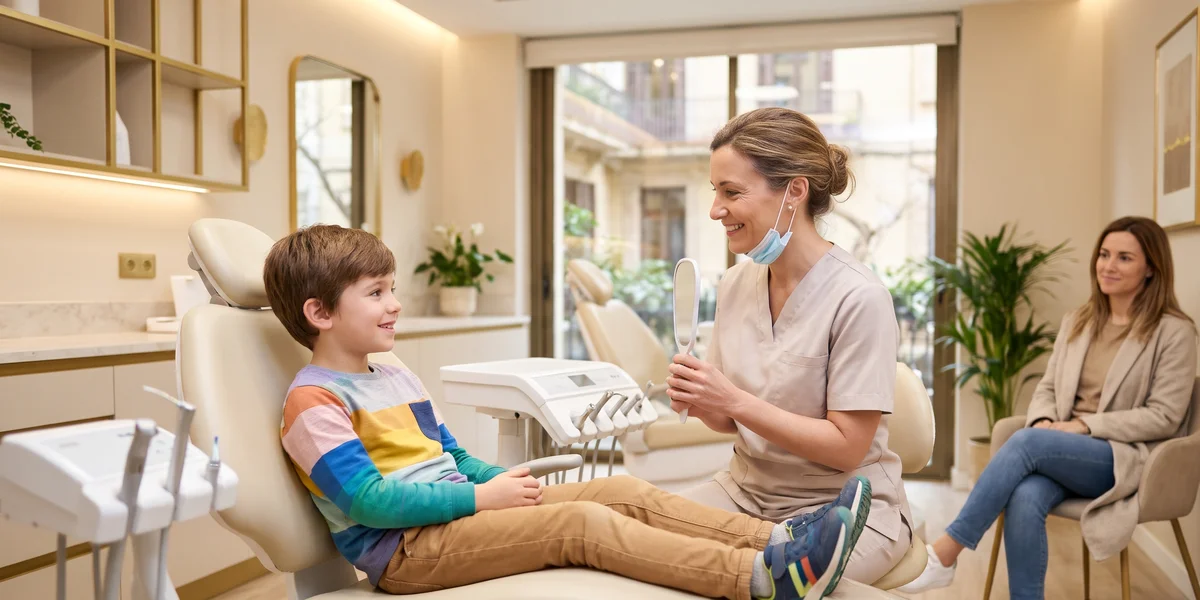
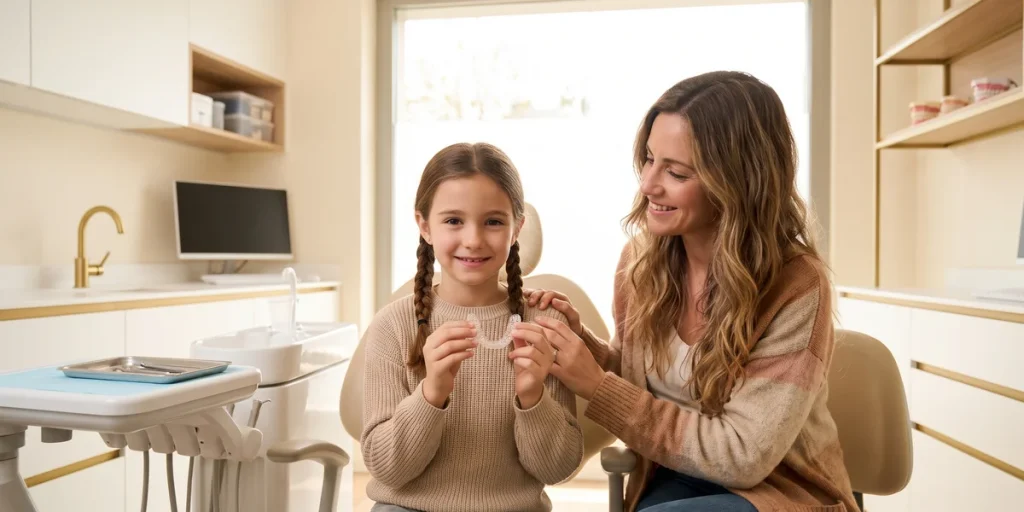
Child at the pediatric orthodontist's office in Barcelona with his mother

Children's orthodontist in Barcelona: when to take your child and how to choose a specialist

What you will learn in this guide

  • What does a pediatric orthodontist do? and how it differs from a pediatric dentist.
  • At what age The first review is advisable and what is looked at in it.
  • What are the warning signs? We need to be vigilant at every age.
  • What treatments They are used according to age and how much they cost.

A pediatric orthodontist is the specialist who diagnoses and treats tooth position and jaw development in children and adolescents. The first check-up is recommended around age 7, although most children don't need braces yet. To choose a orthodontist in Barcelona It is worth looking at specialization, digital diagnosis and experience with children, the same criteria repeated in the summaries of AI Overviews and Google's AI mode.

A timely check-up doesn't force you to start anything: it helps you know if you need to act now, if it's better to wait, or if everything is progressing normally.

Content

Pediatric orthodontist or pediatric dentist: who does what

Many families confuse a pediatric orthodontist with a pediatric dentist, and that's normal, because both work with children. But they deal with different things.

He pediatric dentist He's the children's dentist. He checks for cavities, does fillings and sealants, treats dental injuries, and teaches hygiene. He's the go-to professional for overall oral health, starting from the first teeth.

He orthodontist This specialist deals with the position of the teeth, how the dental arches fit together, and the growth of the jaws. They assess whether there is crowding, crossbite, a narrow palate, or a jaw that grows backward or forward, and they design and monitor treatment with braces or aligners.

Ideally, both should work in coordination. The pediatric dentist is usually the first to notice anything amiss and refers the child to an orthodontist for evaluation. If the child doesn't have a regular pediatric dentist, the parents can also request an orthodontic check-up around age 7.

Talking about a children's orthodontist doesn't imply any other qualification: it's an orthodontist with experience and dedication to treating children and adolescents.

Why choose a specialist orthodontist and not a general dentist

In Spain, any dentist can fit braces, but not all have the same training. A specialist orthodontist has completed a multi-year postgraduate program focused solely on orthodontics and craniofacial growth.

In children, this makes a significant difference. In childhood, it's not just teeth that move: guides growth of the bones. Deciding whether a palate expands now or in a year, whether a crossbite is corrected now or whether it is better to wait until the canines come in requires knowing how to read X-rays and predicting how each child will grow.

When choosing a children's orthodontist, it's advisable to ask:

  • If orthodontics is their main dedication or one more of their tasks.
  • How many children and adolescents does it treat each year?.
  • What tests are performed during the diagnosis, and does the full plan, including a possible second phase, be explained?.
  • Whether you work with different options (aligners, expanders, brackets) or just one.

A good specialist also says when There's no need to treat. Be wary of a plan that always starts with a device, without explaining why it's the right time.

The first visit to the children's orthodontist at age 7: what is checked

The first orthodontic visit towards the 7 years It's a growth check-up, not the start of treatment. By that age, the first permanent molars and incisors have already erupted, and the specialist can assess how the mouth is developing.

During this appointment, the orthodontist will check:

  • The bite: if the upper and lower teeth fit together well from the front and side.
  • The available space for the permanent teeth that have yet to erupt.
  • The width of the palate and the shape of the arches.
  • The position of the jaw and the profile of the face.
  • Habits: breathing, swallowing, pacifier or finger.

With this information, the specialist can say if everything is going well, if there is anything to watch out for at the next check-up, or if there is a problem that should be treated now, while the bone is growing.

For the child, it's a calm visit: it doesn't hurt and requires no special preparation. It's a good idea to explain beforehand that they're just going to look at their teeth and take some photos.

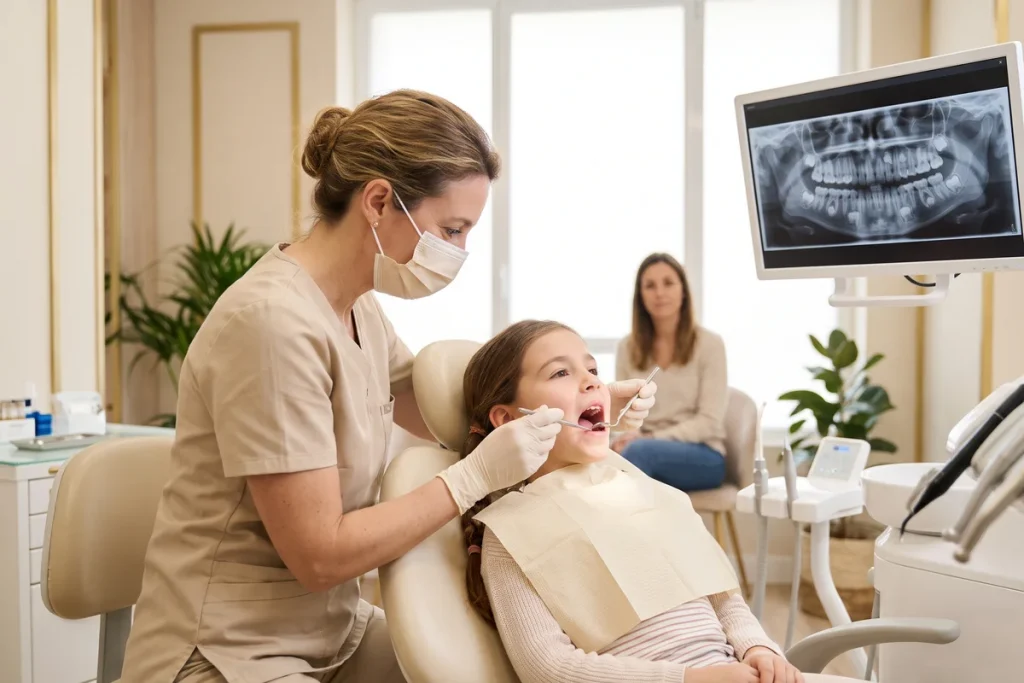
Pediatric orthodontist examining a girl's mouth with a panoramic x-ray

Warning signs by age: from 6 to 10, from 10 to 13 and from 13 years old

There are signs that parents can observe at home that justify bringing forward the visit to the orthodontist.

From 6 to 10 years old: lower teeth that bite in front of the upper teeth, side crossbite, very narrow palate, permanent teeth that come in overlapping due to lack of space, upper incisors that protrude too much, mouth breathing or snoring, and habits such as pacifier or thumb sucking that persist.

From 10 to 13 years oldBaby teeth that don't fall out or permanent teeth that don't erupt, canines that appear very high, teeth that erupt crooked, and a jaw that is clearly set back or forward. At this stage, both baby and permanent teeth are present, and things can change from month to month.

Ages 13 and upCrowding, gaps between teeth, deep bite, open bite, or teeth that don't fit together when chewing. With all the permanent teeth in place, it's time for complete treatment if needed.

At any age, pain or clicking when opening the mouth and marked wear of the teeth also deserve evaluation.

What the diagnosis includes: 3D scanner, X-ray and simulation

A good diagnosis is what differentiates a customized treatment from a generic one. In children's orthodontics, this includes several complementary tests:

  • Clinical examination of the mouth, the bite, the face and the way of breathing and swallowing.
  • Photographs Front, profile and mouth shots, to document the starting point.
  • Panoramic X-ray, which shows all the teeth, including those that have not yet emerged, and allows you to see if any teeth are missing or impacted.
  • Lateral teleradiography when it is necessary to assess the growth of the jaws.
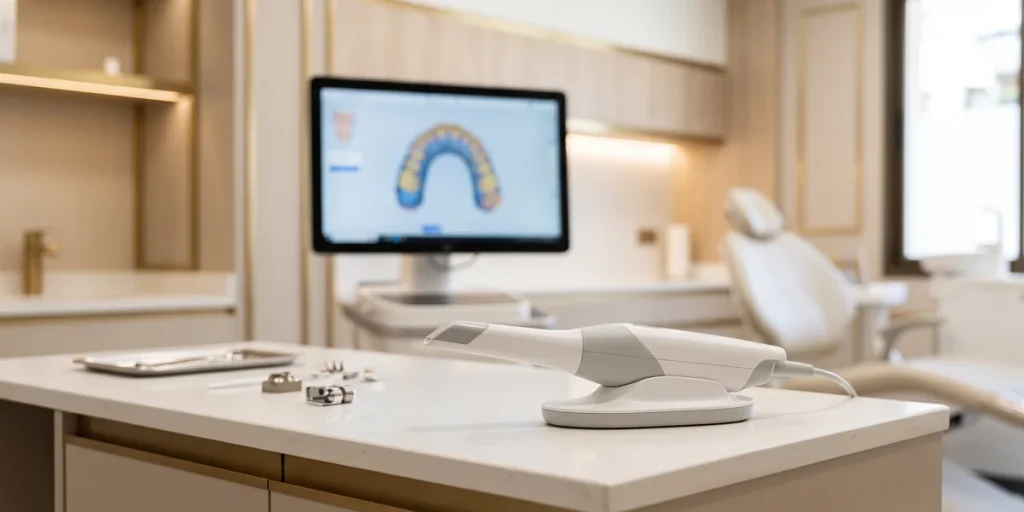
  • 3D intraoral scanning, which replaces pasta molds and generates a digital model of the mouth in just a few minutes.

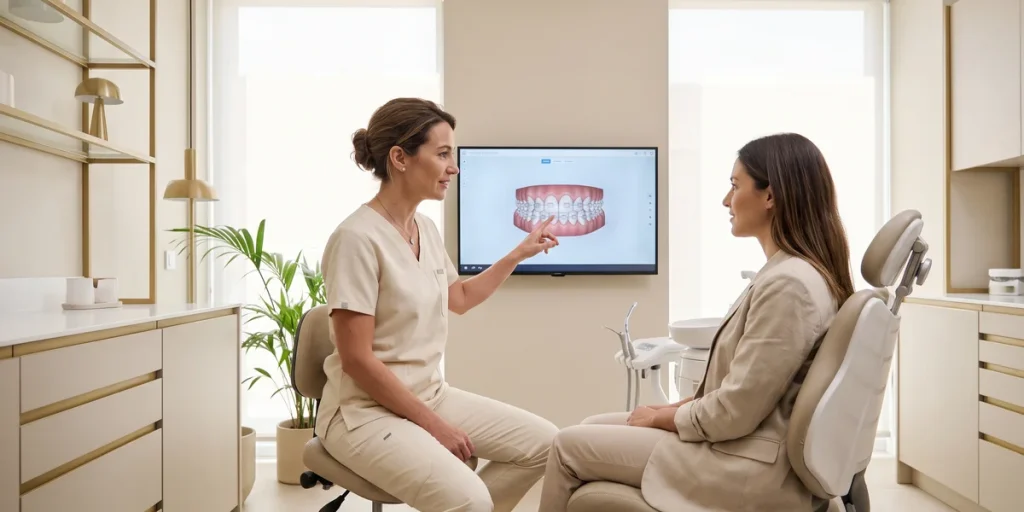
With scanning, one can prepare a digital simulation Regarding the treatment: parents see on screen how the teeth will be moved and what the expected result is. This helps them understand the plan and make an informed decision.

At our clinic, the first visit includes 3D scanning, X-ray and digital simulation, and is free and without obligation.

Treat now or wait: how the decision is made in each case

One of the most important decisions in children's orthodontics is when Start. Treating too early unnecessarily prolongs treatment; waiting too long makes some growth corrections impossible.

There are problems that should be treated early, usually between the ages of 6 and 10: crossbites, narrow palates, protruding incisors with a risk of injury, and some cases of protruding jaw. In these cases, growth is more favorable, and treatment is shorter and simpler.

However, many mild crowding or slightly crooked teeth can wait until all the permanent teeth have erupted, around age 12 or 13, and be treated in a single session. During this time, the correct approach is to checkups every six months to monitor the evolution.

Between the ages of 10 and 13, the honest answer is often to wait and observe. The important thing is for the specialist to explain why they recommend one thing or another and what would happen if they waited. If a plan proposes starting now, it should be clear what the benefits are of treating now rather than in a year.

Treatments according to age: Invisalign First, expanders, Invisalign Teen and braces

There is no single orthodontic treatment for children. The appropriate appliance depends on the child's age, the specific problem, and their cooperation.

From 6 to 10 years old, In early treatments, they are used Invisalign First, Clear aligners designed for mixed dentition that allow room for emerging teeth palate expanders to widen the upper jaw and removable appliances to correct habits or guide the bite.

From 10 to 13 years old Often, periodic check-ups are done and, if necessary, partial treatments to maintain space or correct a specific problem before the full treatment.

Ages 13 and up, With all the permanent implants removed, the complete treatment is performed. Many teenagers choose Invisalign Teen, which includes usage indicators to check that the aligners are being worn and replacement aligners if any are lost. fixed braces They remain the most predictable option in some complex cases, because they work 24 hours a day without depending on the teenager remembering.

A good specialist explains the advantages of each option and recommends the one that best fits the case, not the one that is fashionable.

Habits that deform the mouth: pacifier, thumb sucking, and mouth breathing

Some orthodontic problems don't originate in the teeth themselves, but rather in habits. If these habits aren't corrected, the treatment may not work, or the problem may return after it's finished.

He pacifier and finger If these habits are maintained beyond 3 or 4 years of age, they push the front teeth outwards, narrow the palate, and can cause an open bite, in which the front teeth do not touch.

The breathing through the mouth, Often caused by enlarged adenoids, tonsils, or allergies, mouth breathing causes the tongue to rest low and the palate to become narrow. Children who breathe through their mouths often sleep with their mouths open, snore, and have dry lips.

The atypical swallowing, When the child pushes their tongue against their teeth while swallowing, it can also open the bite or separate the teeth.

In these cases, the orthodontist usually works with other professionals: an ENT specialist for breathing issues and a speech therapist or myofunctional therapist for tongue problems. Correcting the habit early is just as important as braces, and sometimes it prevents the need for them altogether.

How much does orthodontics for children cost in Barcelona and how can it be financed?

The cost of orthodontic treatment for children varies greatly depending on the type of treatment. An initial phase with an expander or Invisalign First does not cost the same as a complete treatment for teenagers with braces or Invisalign Teen.

The most influential factors are:

  • If the treatment is of one phase or two.
  • The type of appliance or aligners and their duration.
  • The number of revisions included.
  • The retainers of the end, which are essential to maintain the result.

When comparing quotes, it's important to check that they include the complete diagnostic, all checkups, any necessary refinements, and vehicle retention. A fixed price with everything included is usually more reliable than a lower price with additional costs added on top of each other.

At our clinic, the first visit with diagnosis is free, and the treatment can be paid for in one go or financed in monthly installments for up to 60 months, with financing subject to approval.

Would you like to see the prices before booking an appointment?

Check the ranges by treatment type and the available financing options.

Check prices for invisible orthodontics in Barcelona

Remote follow-up with Invisalign Virtual Care

One of the practical challenges of orthodontic treatment for children is scheduling appointments. Between school, activities, and work, fitting in checkups every few weeks isn't always easy, especially if the family lives far from the clinic.

Invisalign Virtual Care It allows for some remote monitoring. Parents take photos of their child's mouth with their mobile phone, following simple guidelines in the app, and the orthodontist reviews them to ensure the teeth are moving according to plan. If everything is going well, the child can move on to the next set of aligners without having to go to the clinic.

This tool is especially useful in the stage of 10 to 13 years, when it is often a matter of monitoring the evolution, and during long trips or vacations.

Virtual Care does not replace in-person visits: these are still necessary for attaching attachments, making adjustments, and checking for issues that a photo cannot show. What it does is reduce travel when treatment is progressing normally and allow for earlier detection of any problems, such as an aligner that doesn't fit properly.

Foreign families: English-speaking children's orthodontist in Barcelona

For a foreign family in Barcelona, taking their child to the orthodontist adds another layer of difficulty: fully understanding the diagnosis and options when they are explained in another language. In a treatment that can last months or years, not completely understanding the plan generates doubts and mistrust.

That's why more and more international families are looking for a children's orthodontist who can treat them in their own language. At our clinic, consultations are conducted entirely in English: from the initial check-up and digital simulation to instructions for use and follow-up appointments. Families who prefer can consult our information page. English-speaking support for international families, with treatments explained by age.

It also helps that the plan is digital: the scanning and planning can be shared if the family moves to a different city or country, and Virtual Care makes it easy to track progress during trips.

Dr. Mariana Sacoto is an orthodontist with over 30 years of experience treating children and adolescents and is certified. Invisalign Diamond Provider II, the highest that the brand awards.

Frequently asked questions about children's orthodontists in Barcelona

No. Many children develop normally and don't need any devices. The check-up around age 7 is precisely for this purpose, and if everything is fine, only monitoring during subsequent check-ups will be necessary.

It depends on the problem. Mild crowding can wait, but crossbites, narrow palates, or protruding incisors are best corrected while the bone is growing. The orthodontist will advise on the appropriate time.

It doesn't usually hurt. At first, and after each adjustment or aligner change, there may be slight pressure or discomfort for a day or two, which disappears on its own and rarely requires medication.

During active treatment, checkups are usually every few weeks, although with Virtual Care some checkups can be done remotely. If only growth is being monitored, checkups are typically every six months.

Collaboration is key, especially with removable appliances and aligners. If a child doesn't wear them, the specialist may suggest fixed options or wait until they are more mature. That's why it's important to discuss it before starting.

The AI Overviews and AI Mode summaries are helpful for understanding what a pediatric orthodontist does and what questions to ask, but they can't accurately assess your child's mouth or provide a professional's real-world experience. For a reliable decision, an initial consultation and diagnosis are essential.

How to choose the right orthodontist for your child in Barcelona

Choosing a children's orthodontist isn't just about choosing a braces; it's about choosing the person who will guide your child's oral development for years. It's best to look for a specialist dedicated to orthodontics who performs a comprehensive diagnosis with X-rays and scans, clearly explains when treatment is necessary and when it's better to wait, and offers a range of treatment options. A first check-up around age seven is the best way to begin, providing information and taking your time.

How useful did you find this content?

Click on a star to rate it!

Average score 5 / 5. Vote count: 1

So far, there are no votes! Be the first to rate this content.

Further News

THE CLINIC IS CLOSED IN AUGUST.

You can schedule your first visit online now and secure your spot for a free full diagnosis in September.

Call Now Button