Invisalign Articles
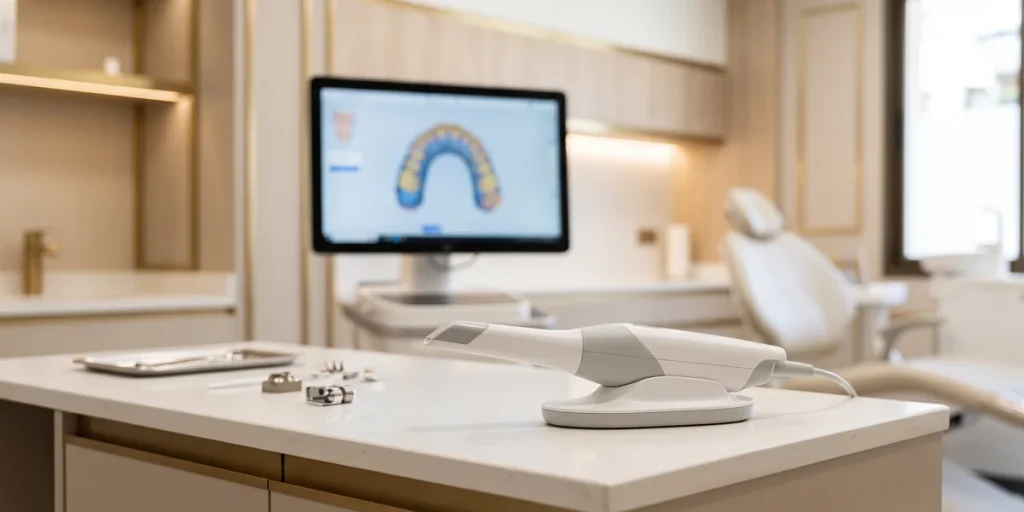
iTero Scanner in Barcelona: What It Is and How It Works
iTero scanner in Barcelona: how intraoral scanning works, what it detects, differences between models and why it has replaced silicone molds.
Orthodontics and digital smile design
Orthodontics and digital smile design
Orthodontics and dental aesthetics

Can't you fully close your teeth when you bite down? Do you notice a gap between your upper and lower teeth when you close your mouth? You probably have open bite, one of the most frequent malocclusions.
In this comprehensive guide, we explain exactly what an open bite is, why it occurs, its consequences, and the most effective treatments for correcting it. If you are looking for specialists in Invisible orthodontics in Barcelona, We can help you regain a functional bite and a balanced smile.
Front page » blog » How to Correct an Open Bite: Treatments and Solutions
The open bite It is a type of dental malocclusion characterized by the inability to completely close the mouth.
When a person with an open bite brings their teeth together, it leaves a visible space between the upper and lower teeth. That is, some teeth do not make contact with their antagonists.
This space most commonly appears in the anterior area (front teeth), although it can also affect the posterior area (molars) or both sides of the mouth.
This malocclusion can cause significant functional problems, such as difficulty biting, chewing, or pronouncing certain sounds correctly.
There are several types of open bite depending on their location and origin:
Depending on the affected area:
Anterior open bite: This is the most common type. The front teeth (incisors and canines) do not touch when the mouth is closed, leaving a visible gap.
Posterior open bite: The molars and premolars do not make proper contact. This is less common but can cause significant chewing problems.
Full open bite: It affects both the anterior and posterior areas. Only some molars are in contact.
According to their origin:
Dental open bite: The problem lies in the position of the teeth. The jawbones are fine.
Skeletal open bite: The problem lies in the size or position of the jawbones. It requires more complex treatments.
An open bite can be caused by different factors:
Prolonged childhood habits: Thumb sucking, using a pacifier beyond the age of 3, or sucking on objects can prevent teeth from erupting correctly.
Atypical swallowing: Placing the tongue between the teeth when swallowing pushes the teeth outwards and keeps the space open.
Mouth breathing: Habitually breathing through the mouth (due to allergies, adenoids, etc.) alters the development of the jaws.
Genetics: The size and shape of the jawbones are inherited. If there is a family history, there is a higher risk of an open bite.
Abnormal bone growth: Excessive vertical growth of the jaws can cause skeletal open bite.

These are the signs that may indicate you have an open bite:
Visible space when closed: The most obvious symptom. When you put your teeth together, there is a gap between the upper and lower teeth.
Difficulty biting: Problems cutting food with the front teeth (biting a sandwich, an apple...).
Pronunciation problems: Difficulty pronouncing certain sounds such as "s", "z", "t", or "d". Lisping is very common.
Mouth breathing: Tendency to breathe through the mouth instead of the nose.
Dry mouth: Breathing through the mouth causes dryness which can promote cavities and gum problems.
Jaw pain: Discomfort in the temporomandibular joint (TMJ) due to overload when chewing.
If left uncorrected, an open bite can cause various problems:
Chewing problems: Since the front teeth cannot cut, the back area is overloaded, making it difficult to properly grind food.
Tooth wear: Teeth that do make contact suffer excessive overload and wear down prematurely.
ATM problems: Pain, clicking, or locking in the jaw joint due to muscle tension.
Speech disorders: Lisping and difficulty pronouncing certain sounds, which can affect communication and self-esteem.
Digestive problems: Poor chewing can hinder digestion.
Aesthetic impact: An open bite can affect facial harmony and confidence when smiling.
An open bite can be corrected at any age, but the treatment varies:
Children (6-9 years): This is the ideal age for intervention. Bones are growing and malleable. Interceptive orthodontics can guide bone development and eliminate harmful habits. Treatments are simpler and faster.
Adolescents (12-18 years): The bones have finished growing, but the teeth move easily. Braces or clear aligners are used.
Adults: It is also possible to correct an open bite. In cases of dental origin, orthodontics is used. In severe skeletal cases, orthognathic surgery may be necessary.
The earlier it is detected and treated, the simpler the treatment will be. A first visit to the orthodontist is recommended at age 6.
The treatment to correct an open bite depends on its cause, severity, and the patient's age:
Interceptive orthodontics (children): Appliances that guide the growth of the jawbones and correct habits. Includes tongue cribs to prevent tongue thrusting or thumb sucking.
Braces: Fixed braces are very effective for closing an open bite. They can be metal, sapphire, or lingual.
Invisible orthodontics (Invisalign): Removable clear aligners that correct tooth position. Highly effective for open bites of dental origin.
Microscrews: Small titanium screws that help intrude molars and close the bite.
Orthognathic surgery: In severe cases of skeletal origin, the jawbones are surgically repositioned.
The invisible orthodontics It is a very effective option for correcting many cases of open bite.
How does it work? Custom-made, clear aligners are used to gradually move the teeth. In the case of an open bite, they work to intrude the molars and extrude the front teeth until contact is achieved.
Is it effective for open bite? Yes, especially in cases of mild to moderate dental origin. It can be combined with micro-screws for greater effectiveness. In severe skeletal cases, it may not be sufficient.
Advantages:
– Practically invisible.
– Removable for eating and brushing.
– Comfortable, without chafing.
– Predictable results with 3D digital planning.
The orthodontist will assess whether it is the appropriate treatment for your specific case.
The orthognathic surgery It is reserved for cases of severe open bite of skeletal origin.
When is it necessary?
– When the problem lies in the size or position of the jawbones, not just the teeth.
– In adults with severe skeletal open bite.
– When orthodontics alone cannot achieve a functional and stable result.
What does it consist of? The maxillofacial surgeon repositions the jawbones using osteotomies (controlled cuts in the bone). This is always combined with orthodontics before and after surgery.
Results: In addition to correcting the bite, it improves chewing function, breathing, speech, and facial harmony. The results are permanent and highly satisfactory.
Many cases of open bite do NOT require surgery and are resolved with orthodontics alone.
He speech therapist It plays a fundamental role in the treatment of open bite, especially when it is caused by incorrect habits.
Why is it important? If the habits that caused the open bite (atypical swallowing, tongue thrust, etc.) are not corrected, there is a risk of recurrence: the bite may reopen after treatment.
What does myofunctional therapy consist of?
– Re-education of the position of the tongue at rest.
– Correction of the swallowing pattern.
– Exercises to strengthen the perioral muscles.
– Improvement in the pronunciation of affected sounds.
When does it take place? Ideally, this should be done in parallel with or after orthodontic treatment. The younger the patient, the easier it is to modify habits.
Working together as an orthodontist and a speech therapist ensures more stable results.
The duration of treatment to correct an open bite varies depending on several factors:
Interceptive orthodontics (children): Between 6 and 12 months of active treatment.
Orthodontics with braces or aligners: Between 12 and 24 months in most cases.
Orthodontics + orthognathic surgery: Between 24 and 36 months in total, including the pre- and post-surgical phases.
Factors that influence:
– Severity of the open bite.
– Dental or skeletal origin.
– Patient's age.
– Patient cooperation.
– Need to correct habits with speech therapy.
Mild cases may resolve in less than a year. Complex cases requiring surgery may take up to 3 years.
Yes, in most cases. Surgery is only necessary for severe open bites of skeletal origin. Those of dental origin are perfectly corrected with orthodontics (braces or clear aligners).
In many cases, yes, especially if the open bite is of mild or moderate dental origin. It can be combined with micro-screws to improve effectiveness. Your orthodontist will assess whether it's the right option for you.
The treatment itself is not painful. It is normal to feel pressure or mild discomfort for the first few days after each adjustment or aligner change, but these are temporary and tolerable.
There is a risk of recurrence if the habits that caused the open bite (atypical swallowing, tongue thrust, etc.) are not corrected. Therefore, speech therapy and the use of retainers after treatment are essential.
Yes, it's very common. An open bite can cause a lisp and difficulty pronouncing sounds like 's', 'z', 't', or 'd'. Correcting the bite usually improves these problems significantly.
He price of correcting an open bite It depends on the treatment required:
Interceptive orthodontics (children): €1,000 – €2,500
Metal braces: €2,500 – €4,000
Aesthetic brackets (sapphire/ceramic): €3,500 – €5,000
Invisible orthodontics (Invisalign): €3,000 – €5,500
Orthognathic surgery + orthodontics: €15,000 – €25,000
Speech therapy: €30 – €60 per session
Factors that influence:
– Complexity of the case.
– Type of equipment.
– Need for auxiliary elements (micro-screws…).
– Duration of treatment.
Most clinics offer financing. Request a personalized consultation to get an exact quote.
How useful did you find this content?
Click on a star to rate it!
Average score 5 / 5. Vote count: 1
So far, there are no votes! Be the first to rate this content.
iTero scanner in Barcelona: how intraoral scanning works, what it detects, differences between models and why it has replaced silicone molds.
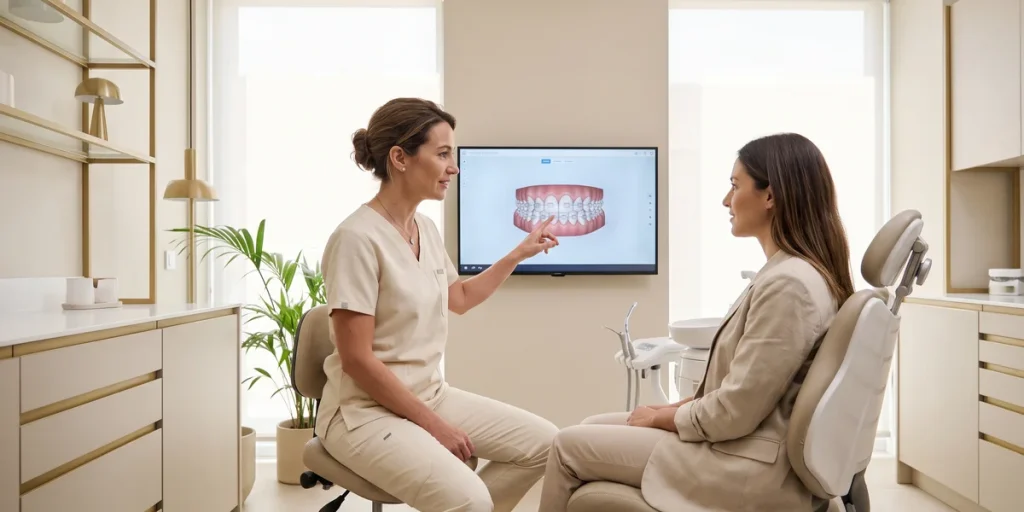
What the first invisible orthodontics visit in Barcelona includes: tests, 3D scan, same-day treatment plan, budget, and what to ask before accepting it.
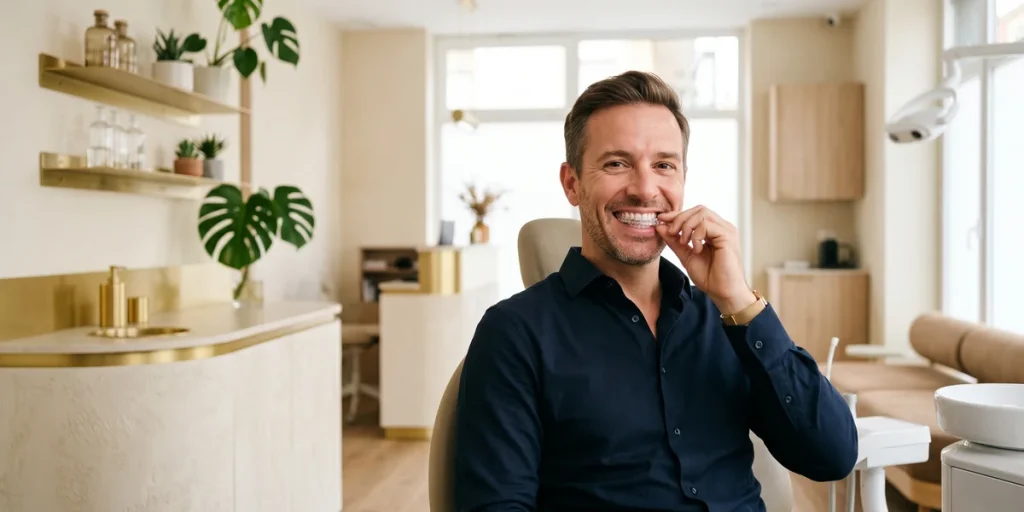
Invisalign Comprehensive in Barcelona: what complex cases it corrects, when it's not enough, how long it lasts, what unlimited aligners mean, and what the price should include.
THE CLINIC IS CLOSED IN AUGUST.
You can schedule your first visit online now and secure your spot for a free full diagnosis in September.