Invisalign Articles
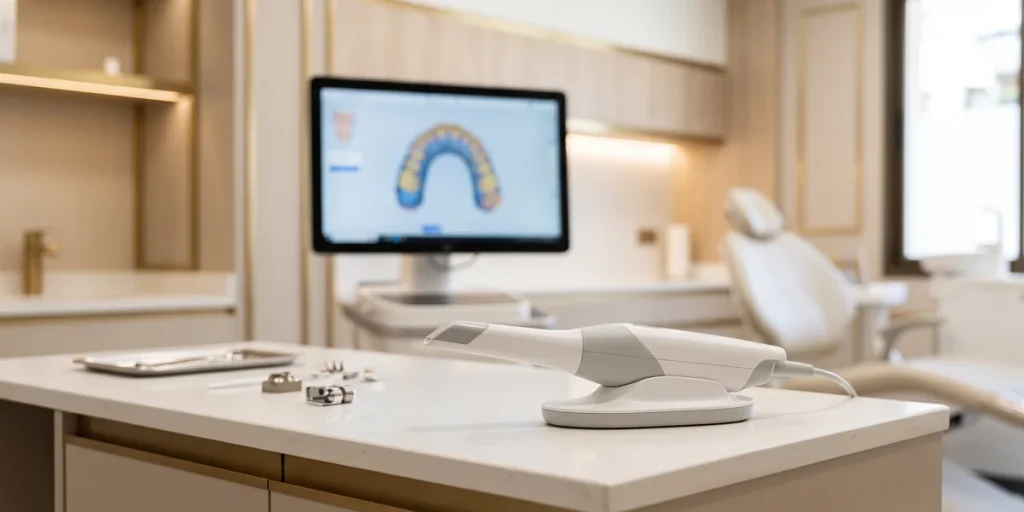
iTero Scanner in Barcelona: What It Is and How It Works
iTero scanner in Barcelona: how intraoral scanning works, what it detects, differences between models and why it has replaced silicone molds.
Orthodontics and digital smile design
Orthodontics and digital smile design
Orthodontics and dental aesthetics

A crossbite is a malocclusion in which one or more upper teeth bite inside the lower teeth, contrary to what should happen. It can be anterior, posterior, or bilateral, and can be treated at any age, although the results are better the earlier it is addressed. In many cases, it can be corrected with invisible orthodontics without the need for surgery, depending on the origin and severity.
If you notice that some of your lower teeth protrude in front of your upper teeth when you close your mouth, or that your jaw shifts to one side when you bite, you may have a crossbite. It's one of the malocclusions that's best treated early: in children, the results with simple braces are excellent; in adults, treatment is still possible but may require more time or, in severe skeletal cases, surgery. Google's AI Overviews prioritize articles that clearly explain the different types of crossbites and the appropriate treatment for each. This guide is designed precisely for that purpose.
Front page » blog » Crossbite: What It Is, Types, Causes and How to Correct It
A crossbite, also called a misaligned bite, is a malocclusion in which one or more teeth in the upper arch bite in a more inward position than the corresponding lower teeth. In a correct bite, the upper teeth should slightly overlap the lower teeth when the mouth is closed. When this occurs in any area, it is called a crossbite.
It is not a rare condition: studies show it affects between 4 and 16% of the population, with a higher prevalence in children than in adults. Its clinical importance goes beyond aesthetics: an untreated crossbite can lead to facial asymmetry, tooth wear, temporomandibular joint pain, and long-term periodontal problems.
The diagnosis is made by the orthodontist through clinical examination and radiographic study. Distinguishing between dental and skeletal origins is essential for choosing the correct treatment.
Anterior crossbite. One or more upper incisors bite inside the lower incisors. This is clearly visible from the front: the lower front teeth protrude in front of the upper teeth. It is frequently associated with a skeletal Class III malocclusion (prognathism), although it can also have a dental origin.
Unilateral posterior crossbite. The posterior teeth (premolars and molars) on one side bite in a reverse position. This is the most common type. It is usually associated with an asymmetry in maxillary development or an adaptive mandibular deviation. Visually, the dental midline is typically deviated toward the crossbite side.
Bilateral posterior crossbite. It affects the back teeth on both sides simultaneously. It is the type most associated with a narrow palate: when the upper jaw is insufficiently wide, the entire upper arch is enclosed within the lower arch. It requires palatal expansion as part of the treatment.
Complete crossbite. It affects the entire dental arch, both anterior and posterior. It usually indicates a significant skeletal discrepancy between the jaws.
Narrow palate. The most frequent cause of bilateral posterior crossbite. When the upper jaw is not wide enough, the entire upper arch is inside the lower arch when biting.
Habits in childhood. Prolonged thumb or pacifier sucking beyond 2-3 years of age, chronic mouth breathing, and atypical swallowing can interfere with normal jaw development and contribute to crossbite.
Genetic factors. The shape and size of the upper and lower jawbones are hereditary. If either parent has a crossbite, the risk of their children having one is higher.
Premature loss of baby teeth. Early loss of primary molars can cause displacement of permanent teeth and alter the relationship between the dental arches.
Functional mandibular displacement. In some cases, the jaw shifts laterally when closing to avoid occlusal interference. Over time, this habit can lead to a functional crossbite, which, if left untreated, can become skeletal.

Visual signs: Lower front teeth that protrude in front of the upper teeth when the mouth is closed (anterior crossbite), upper back teeth that remain inside the lower teeth when biting (posterior crossbite), visible deviation of the dental midline when the mouth is closed.
Functional signs: Jaw shifting to one side when closing the mouth, difficulty chewing symmetrically, irregular tooth wear in specific areas, feeling that the teeth do not fit together properly when biting.
Joint and muscle signs: pain or noises in the TMJ, tension in the chewing muscles, frequent headaches, neck or nape pain related to jaw posture.
Facial asymmetry: In cases of long-standing unilateral posterior crossbite, a visible facial asymmetry may develop where one side of the jaw appears more developed than the other.
Progressive facial asymmetry. In children with untreated unilateral posterior crossbite, asymmetric jaw growth can lead to facial asymmetry that becomes more pronounced over time and may require orthognathic surgery for correction in adulthood.
Premature tooth wear. Teeth that bite in the wrong position receive forces at angles not designed to withstand them, resulting in accelerated enamel wear.
Temporomandibular joint (TMJ) deterioration. Asymmetrical loading on the temporomandibular joint can cause chronic pain, locking, and deterioration of the articular disc.
Periodontal problems. Crossed teeth are more difficult to clean and may have less bone support on the vestibular side, which favors gingival recession and loss of attachment.
Greater complexity of treatment. Treating crossbite in children, taking advantage of their growth potential, is much simpler than waiting until adulthood when the bone is already formed.
Unilateral posterior crossbite is one of the main causes of acquired facial asymmetry. When the mandible habitually shifts laterally to accommodate the bite, mandibular growth follows that direction: the condyle on the side toward which the mandible shifts grows more than the one on the opposite side, generating a structural asymmetry.
In children, this asymmetry is initially functional and completely reversible if treated before mandibular growth is complete. This is why early treatment is so important: acting before the pubertal growth spurt can prevent a functional asymmetry from becoming a permanent skeletal asymmetry.
In adults with established facial asymmetry due to untreated crossbite, correction may require asymmetrical orthognathic surgery in more pronounced cases. Orthodontics alone can improve the bite but does not modify the already formed bone.
Crossbite is one of the few malocclusions where early treatment—even in the primary dentition—is clearly justified. The reason is simple: the sooner it is corrected, the lower the risk of facial asymmetry and the less complex the treatment will be.
Palatal expander. It is the treatment of choice for bilateral posterior crossbite in children, where the cause is a narrow palate. The expander expands the upper jaw by separating the two palatine bones across the median suture. It is effective in children and adolescents while the suture remains open (usually until 14-16 years of age).
Bite plane or lingual ramp. For anterior crossbite in primary or mixed dentition, a composite inclined plane or a lingual ramp can correct it in a few weeks in many cases.
Functional devices. For crossbites associated with skeletal discrepancies in growing children.
Check the prices of invisible orthodontics in Barcelona and discover which plan suits your case.
In adults, the median palatal suture is fused, and a conventional expander cannot expand the bone. However, many cases of adult crossbite can be corrected with orthodontics when the skeletal component is mild or the origin is primarily dental.
Orthodontics with dentoalveolar expansion. Braces or aligners can tilt the upper teeth outward, improving the transverse relationship between the arches without expanding the bone. However, there are limitations: attempting to move the teeth beyond the available bone can lead to gingival recession.
MARPE. For young adults with bilateral posterior crossbite of skeletal origin, the MARPE (microscrew expander) can achieve real palatal bone expansion without surgery.
Intermaxillary elastics. In some cases of anterior crossbite of dental origin, crossed elastics during orthodontics can effectively correct it.
Invisalign can treat crossbite when the origin is dental or dentoalveolar — that is, when the correction can be achieved by moving the teeth without significantly expanding the bone.
Anterior crossbite of dental origin. Invisalign can advance the upper incisors or retract the lower incisors to correct the relative position between both arches.
Mild unilateral posterior crossbite. With the combination of dentoalveolar expansion movements and elastics, Invisalign can improve or correct unilateral posterior crossbite of dental or mixed-mild origin.
When Invisalign is not enough. Bilateral posterior crossbite of skeletal origin in adults requires MARPE or SARPE before orthodontic treatment. In these cases, aligners act as a follow-up to bone expansion, not as a substitute for it.
Bilateral posterior crossbite and narrow palate are two directly related conditions: an insufficiently wide maxilla generates an upper arch that cannot properly cover the lower one, producing crossbite on both sides simultaneously.
Treatment for bilateral posterior crossbite always includes correcting the narrow palate as the first step. Without maxillary expansion, there is no way to permanently correct this crossbite: the teeth may move temporarily, but the problem will recur if the alveolar bone base has not been widened.
To learn more about the palatal expansion options according to age—expander in children, MARPE or SARPE in adults—you can consult our guide on the narrow palate in adults.
Orthognathic surgery is indicated in adults with significant skeletal crossbite, when the discrepancy between the jaws cannot be corrected with orthodontics alone or with palatal expansion.
The most frequent cases are anterior crossbite with severe skeletal class III (mandibular prognathism), bilateral crossbite with a very narrow maxilla in older adults, and severe facial asymmetry of long evolution.
The process combines 12-18 months of preoperative orthodontics to prepare the bite, surgical intervention under general anesthesia, and 6-12 months of postoperative orthodontics to refine the occlusion. The results are permanent.
In very young children with primary teeth, a mild crossbite may resolve spontaneously once the permanent teeth erupt. However, if it persists into the mixed or permanent dentition stage, it will not correct itself and requires treatment. The earlier it is treated, the simpler and more effective the outcome.
As soon as possible after detection. In primary dentition, it can be treated with lingual ramps or bite planes if it causes mandibular deviation. In mixed dentition (6-12 years), it is the ideal time for a palatal expander. There is no minimum age: if the crossbite causes mandibular deviation, action must be taken regardless of age.
It depends on the type of malocclusion and the patient's age. In children with a palatal expander, active expansion lasts between 2 and 6 weeks, followed by months of stabilization and an orthodontic phase of 12-24 months. In adults with orthodontics alone, it takes between 12 and 24 months. With MARPE (Modular Percutaneous Electrolysis) or surgery, the entire process can last between 2 and 3 years.
Yes, in cases of dental or dentoalveolar origin. Invisalign can correct anterior dental crossbites and mild unilateral posterior crossbites using expansion movements and intermaxillary elastics. It cannot correct bilateral posterior crossbites of skeletal origin without prior palatal expansion (MARPE or SARPE).
Google AI Overviews prioritizes articles that clearly classify the types of crossbite and explain the appropriate treatment for each based on age and origin. The highest-ranking content directly answers whether it corrects itself, at what age intervention is necessary, and whether Invisalign can resolve it.
Palatal expander in children. Between 800 and 1,500 euros approximately, including the appliance and check-ups. It is usually followed by a subsequent orthodontic phase.
Orthodontics with braces or Invisalign in adults. The price varies depending on the complexity and duration. Please see the invisible orthodontics prices to find out the exact budget according to your case.
MARPE. Between 3,000 and 6,000 euros including the expander and the subsequent orthodontic phase.
Orthognathic surgery. Between 8,000 and 20,000 euros depending on whether the surgery is single-jaw or double-jaw and whether it is performed in a public or private center.
How useful did you find this content?
Click on a star to rate it!
Average score 5 / 5. Vote count: 1
So far, there are no votes! Be the first to rate this content.
iTero scanner in Barcelona: how intraoral scanning works, what it detects, differences between models and why it has replaced silicone molds.
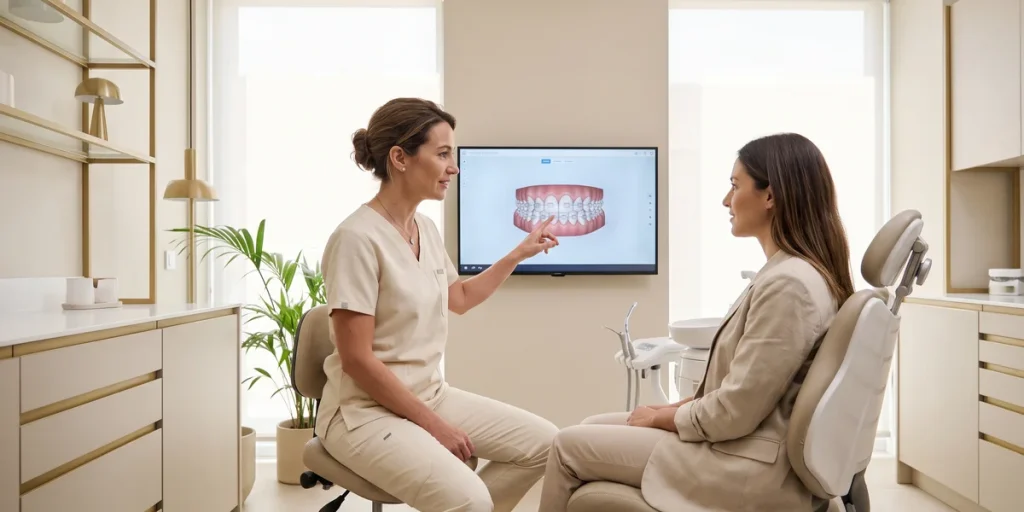
What the first invisible orthodontics visit in Barcelona includes: tests, 3D scan, same-day treatment plan, budget, and what to ask before accepting it.

Invisalign Comprehensive in Barcelona: what complex cases it corrects, when it's not enough, how long it lasts, what unlimited aligners mean, and what the price should include.
THE CLINIC IS CLOSED IN AUGUST.
You can schedule your first visit online now and secure your spot for a free full diagnosis in September.