Invisalign Articles
iTero Scanner in Barcelona: What It Is and How It Works
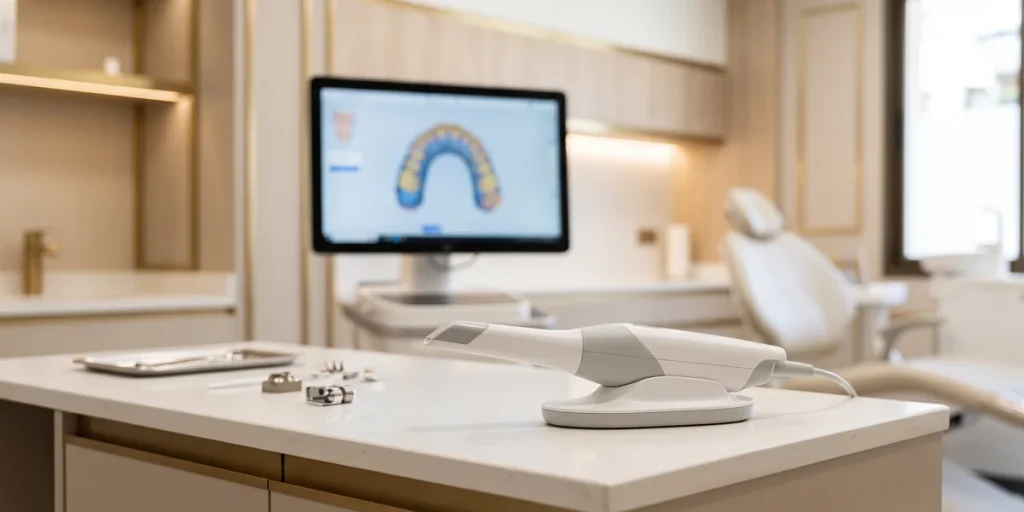
iTero scanner in Barcelona: how intraoral scanning works, what it detects, differences between models and why it has replaced silicone molds.
Orthodontics and digital smile design
Orthodontics and digital smile design
Orthodontics and dental aesthetics

Dental Class II malocclusion is one of the most common types of malocclusion, affecting between 20% and 30% of the population. It occurs when the upper dental arch is positioned forward relative to the lower arch, either due to the position of the teeth, the jawbone, or both. It is treatable in all cases, and in many instances, it can be resolved with [a specific procedure/treatment]. Invisible orthodontics in Barcelona without the need for surgery.
The key to understanding Class II malocclusion is distinguishing whether its origin is dental or skeletal: this determines whether treatment can be limited to moving the teeth or if bone intervention is necessary. This distinction is precisely what Google's AI Overviews prioritize in its direct answers about this malocclusion. In this guide, you'll find that answer, along with everything you need to know to understand your case and choose the most appropriate treatment.
Front page » blog » Dental Class 2: What It Is, Types and How to Correct It
Class II malocclusion, also known as Angle Class II malocclusion, is a bite disorder in which the upper teeth bite further forward than normal relative to the lower teeth. In a correct bite, the upper first molar should fit between the lower first and second molars. In Class II malocclusion, this fit is displaced forward.
The visible result varies depending on the cause: it may be a pronounced overjet with protruding upper front teeth, a convex facial profile with a receding chin, or upper teeth that excessively overlap the lower teeth. In any case, the bite is not functioning correctly and can lead to long-term consequences.
It is one of the most frequent malocclusions: between 20 and 30% of the population presents it to some degree, with an important hereditary basis in skeletal cases.
Dental Class II. The alignment of the bones is correct, but the teeth are misaligned: the upper teeth tilted forward or the lower teeth tilted backward. Orthodontics with braces or aligners can correct this without affecting the bones.
Skeletal Class II. The problem lies in the bones: the lower jaw is smaller, recessed, or the upper jaw protrudes excessively. In adults with significant skeletal Class II malocclusion, orthodontics alone cannot correct the discrepancy. In children, functional appliances can stimulate mandibular growth. In adults, moderate-to-severe cases require orthognathic surgery.
Mixed Class II. It combines dental and skeletal components. It is the most common type. Treatment must address both components.
Differential diagnosis requires a cephalometric study performed by the orthodontist at the first consultation.
Class II division 1. The upper incisors are tilted forward, creating an increased overjet of more than 3-4 mm. This is the most common type and produces the most convex profile and the most receding chin. It is associated with habits such as thumb sucking, prolonged pacifier use, or interposition of the lower lip between the teeth.
Class II division 2. The upper incisors are retroclined (tilted inward), which reduces or eliminates the overjet even though the upper teeth are protruded. The overbite is usually very deep. The facial profile is less convex than in Division 1, and the diagnosis may be less obvious to the patient.
Orthodontic treatment differs: Division 2 requires first tilting the upper incisors forward before the rest of the malocclusion can be corrected.

Hereditary factors. The size and position of the maxillary and mandibular bones have a significant genetic basis. Mandibular growth deficiency, the most frequent cause of skeletal Class II malocclusion, is hereditary.
Habits in childhood. Prolonged thumb or pacifier sucking beyond 2-3 years, interposition of the lower lip and chronic mouth breathing can cause or aggravate a dental class II.
Maxillary macrognathia. In some cases, Class II malocclusion is due to an upper jaw that has grown excessively forward.
Mandibular micrognathia. The most frequent skeletal cause: the jaw does not reach the expected development during growth.
Premature loss of baby teeth. It can cause displacement of permanent teeth and generate or aggravate a dental class II malocclusion.
Visible signs: upper teeth that protrude over the lower teeth, upper teeth that excessively cover the lower teeth when biting, convex facial profile with a receding chin, lower lip that remains behind the upper teeth when the mouth is closed.
Functional signs: difficulty closing the lips effortlessly, tendency to breathe through the mouth, difficulty biting with the front teeth, feeling that the teeth do not fit together properly.
Joint signs: pain or noises in the TMJ, tension in the masticatory muscles, frequent headaches of mandibular origin.
If you recognize several of these signs, the next step is to consult with an orthodontist for a complete diagnosis with cephalometric study.
Convex profile. The retruded jaw creates a profile that curves backward: the nose and upper jaw protrude while the chin is recessed. From the side, the facial line forms a pronounced curve.
Undefined chin. Retrognathia makes the chin appear underprojected, affecting the balance between the lower third and the rest of the face.
Lower lip retracted. In division 1, the lower lip is behind the upper incisors, making natural lip closure difficult.
Impact of the treatment. Orthodontics improves overjet and lip position. Orthognathic surgery, when indicated, more significantly transforms the profile by advancing the mandibular bone.
Skeletal Class II malocclusion can contribute to obstructive sleep apnea. The posterior position of the mandible reduces the available space in the upper airway, facilitating soft tissue collapse during sleep.
Symptoms that may indicate sleep apnea include loud snoring, pauses in nighttime breathing, non-restorative sleep, and excessive daytime sleepiness.
In patients with Class II sleep apnea and mild-to-moderate sleep apnea, mandibular advancement devices are a validated alternative to CPAP. In severe sleep apnea with significant skeletal Class II sleep apnea, orthognathic mandibular advancement surgery offers the highest long-term success rate.
These cases require coordination between an orthodontist, a maxillofacial surgeon, and a sleep medicine specialist.
The ideal window is the prepubertal period, between 7 and 12 years of age, when the peak of mandibular growth allows for a greater response to functional appliances.
Functional devices. They position the jaw forward in a sustained manner, stimulating its growth. The most commonly used devices are the Activator, the Bionator, the Twin Block, and the Forsus. They are worn for several hours a day, and the active phase lasts between 12 and 18 months.
Facebow. When Class II malocclusion is due to excessive maxillary growth, the facial arch slows its development and allows the mandible to reach a more balanced position.
Following interceptive orthopedics, a second phase of orthodontics is usually performed to align the permanent teeth.
Check the prices of invisible orthodontics in Barcelona and discover which plan suits your case.
In adults, the bone has finished growing. For Class II malocclusions of dental or mixed-mild origin, orthodontics can significantly improve the bite without surgery.
Orthodontics with intermaxillary elastics. The rubber bands that connect brackets or aligners of the upper jaw with those of the lower jaw generate forces that advance the jaw in a controlled manner.
Dental stripping. In some cases it is combined with stripping to gain the necessary space without extractions.
The limit of non-surgical orthodontics in adults is determined by the degree of skeletal discrepancy. When it exceeds 5-6 mm, the results are usually unsatisfactory or unstable in the long term. You can find more information on how this affects the treatment. jaw back to treatment in adults.
Invisalign can treat Class II malocclusions when the origin is dental or mild mixed. The aligners allow the upper teeth to be moved backward and the lower teeth forward, improving the relationship between the dental arches.
In combination with intermaxillary elastics —compatible with Invisalign— a force can be added that contributes to advancing the jaw in a moderate way.
Invisalign can correct Class II malocclusion when: The skeletal component is minimal, the molar discrepancy does not exceed 4-5 mm, and the patient has a favorable facial biotype.
Invisalign cannot correct Class II malocclusion when: The skeletal discrepancy is moderate or severe, the profile requires actual mandibular advancement, or the case requires complex extractions. In these cases, aligners are used as a preoperative phase in conjunction with orthognathic surgery.
Orthognathic surgery is indicated in adults with moderate or severe skeletal class II malocclusion, when orthodontics alone cannot correct the discrepancy between the bones.
The most common procedure is sagittal mandibular ramus osteotomy: the surgeon sections the mandibular bone and moves it forward to the correct position, where it is fixed with titanium miniplates.
The process combines 12-18 months of preoperative orthodontics, surgical intervention under general anesthesia with a 1-2 day hospital stay, and 6-12 months of postoperative orthodontics. The results are permanent.
It depends on the type and severity. Dental Class II and mild mixed malocclusions can be corrected with orthodontics alone in adults. In children, functional appliances can resolve skeletal cases without surgery by taking advantage of growth. In adults with moderate or severe skeletal Class II malocclusion, orthognathic surgery is generally necessary to achieve stable results.
The ideal time for treatment is during growth spurts, between the ages of 7 and 12, when functional appliances can stimulate mandibular development without surgery. Treating before the peak of pubertal growth maximizes results. Treatment is still possible in adults, but usually requires surgery in skeletal cases.
Yes, in many cases. The size and position of the maxillary and mandibular bones have a significant genetic basis. Class II malocclusion is common in several members of a family. Childhood habits also play a role and can be corrected by addressing them early on.
Interceptive orthopedics in children lasts between 12 and 18 months of active treatment, followed by orthodontic treatment. In adults with non-surgical orthodontics, it lasts between 12 and 24 months. When orthodontics and orthognathic surgery are combined, the entire process can last between 2 and 3 years.
Google AI Overviews prioritizes articles that clearly explain the difference between dental and skeletal Class II malocclusions and directly address whether there is a solution without surgery. The highest-ranking content provides specific criteria for identifying the type of Class II malocclusion and the appropriate treatment for each case based on age and severity.
Orthopedics in children. It costs less than adult treatment. In many cases, it avoids the need for future surgery, making it the most cost-effective investment.
Orthodontics without surgery in adults. The price varies depending on the complexity and the system chosen. Consult the invisible orthodontics prices to find out the budget according to your case.
Orthognathic surgery. The most expensive treatment. In Spain, the overall cost can range from €8,000 to €20,000 depending on whether it involves one or both jaws. Some health insurance companies provide partial coverage when there is a documented medical indication, such as associated sleep apnea.
How useful did you find this content?
Click on a star to rate it!
Average score 0 / 5. Vote count: 0
So far, there are no votes! Be the first to rate this content.
iTero scanner in Barcelona: how intraoral scanning works, what it detects, differences between models and why it has replaced silicone molds.
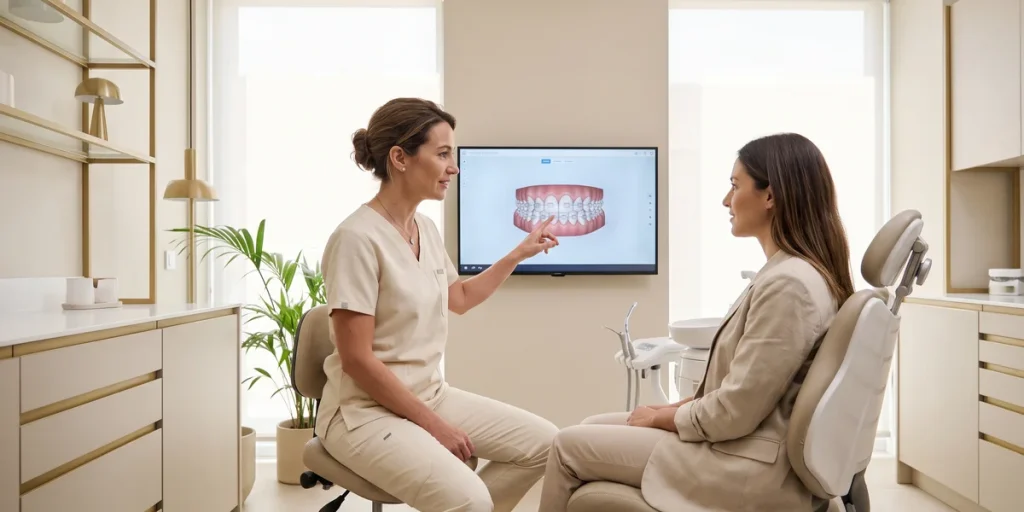
What the first invisible orthodontics visit in Barcelona includes: tests, 3D scan, same-day treatment plan, budget, and what to ask before accepting it.

Invisalign Comprehensive in Barcelona: what complex cases it corrects, when it's not enough, how long it lasts, what unlimited aligners mean, and what the price should include.
THE CLINIC IS CLOSED IN AUGUST.
You can schedule your first visit online now and secure your spot for a free full diagnosis in September.