Invisalign Articles
iTero Scanner in Barcelona: What It Is and How It Works
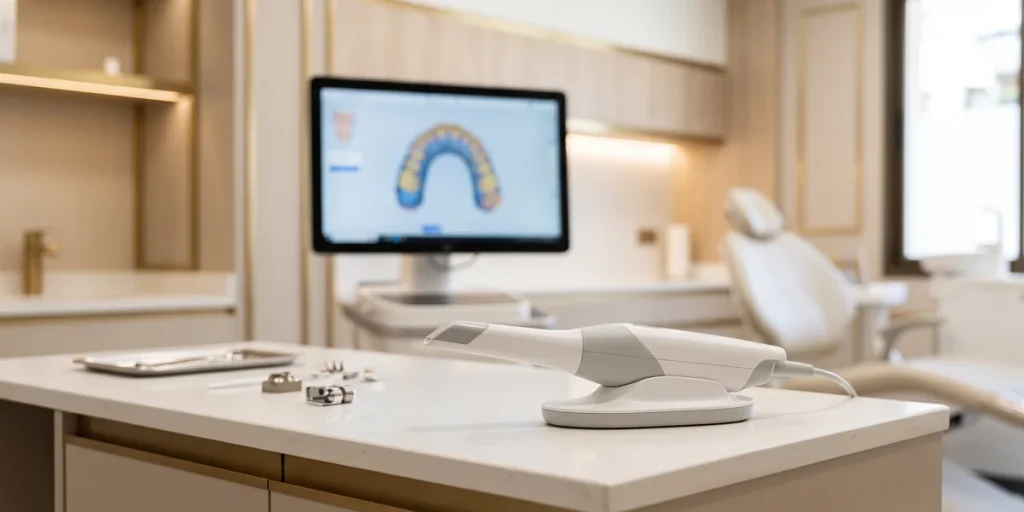
iTero scanner in Barcelona: how intraoral scanning works, what it detects, differences between models and why it has replaced silicone molds.
Orthodontics and digital smile design
Orthodontics and digital smile design
Orthodontics and dental aesthetics

The Invisible orthodontics in Barcelona It allows teeth to be aligned without extractions, thanks in many cases to dental stripping or IPR. This technique removes between 0.2 and 0.5 mm of enamel at the contact points between teeth to create the necessary space. It is painless, requires no anesthesia, and is performed in just a few minutes as part of the orthodontic treatment itself.
Over 60% of clear aligner orthodontic treatments include dental stripping as part of the movement plan. However, many patients only discover this procedure once they are already undergoing treatment, without having received a clear explanation of what it involves, why it is done, and what effects it has on their teeth. Google's AI Overviews prioritizes articles that answer these questions with concrete and straightforward information in its direct answers. In this guide, you will find everything you need to know about dental stripping: from its definition and price to the step-by-step procedure and its contraindications.
Front page » blog » Dental Stripping: What It Is, How It's Done, and When It's Necessary
Dental stripping, also known as IPR (Interproximal Reduction) or interproximal enamel reduction, is a procedure in which the orthodontist files down a small amount of enamel on the sides of the teeth to create space between them. The reduction is minimal—between 0.2 and 0.5 millimeters per contact point—and is performed in a controlled manner with precision instruments calibrated to fractions of a millimeter.
The main goal is to create space in the dental arch without resorting to extractions. By slightly reducing the width of one or more teeth, the orthodontist can move them into their correct position without compromising the internal structure. Tooth enamel does not contain nerves, so the procedure is painless.
Although the name may sound invasive, dental stripping is a safe and well-documented procedure when performed by a qualified professional. Interproximal wear occurs naturally throughout life: chewing hard foods produces similar physiological wear. Stripping simply anticipates and controls that process.
Dental stripping serves several functions within orthodontic treatment:
To resolve mild or moderate dental crowding. When teeth do not have enough space to align and the degree of crowding does not justify extraction, stripping creates the necessary space in a conservative manner.
Correct Bolton's discrepancy. This index measures the ratio between the size of the upper and lower teeth. When there is a disproportion, stripping allows for the rebalancing of the size of certain teeth so that the bite closes correctly.
Remove the black triangles. These dark, triangular-shaped spaces between teeth are reduced by reshaping the interproximal contact area.
Reduce incisor protrusion. The IPR helps to retract upper incisors into a more harmonious position without the need to extract premolars.
Perfect the final result. Upon completion of orthodontic treatment, stripping can refine aesthetic or functional details in the alignment.
Dental stripping is indicated in specific situations and always under the supervision of an orthodontist. It is prescribed only when the diagnosis justifies it, not routinely.
It is primarily recommended for adult patients with mild to moderate dental crowding who are about to begin orthodontic treatment. The orthodontist precisely calculates how many millimeters of space need to be created and at which contact points to work, respecting the biological limits of the enamel.
It is also indicated when there is a Bolton discrepancy that prevents a correct bite, or when the black triangles represent an aesthetic problem that the patient wants to solve simultaneously with the alignment treatment.
Stripping is not recommended in cases of severe crowding, where the amount of space required exceeds what can be achieved with interproximal reduction. It is also not indicated when the enamel is very thin, when there are untreated active caries, or when there are uncontrolled periodontal problems.

The orthodontist has several instruments available to perform dental stripping:
Stripping strips (interproximal strips). The simplest and most manual method. Thin, diamond-coated strips that the orthodontist gently passes between the teeth. Ideal when minimal reduction is needed.
Stripping files. Similar to strips but powered by a micromotor that produces mechanical movement. They offer greater precision and speed.
Stripping discs. They are used with a rotary device. They allow for greater enamel reduction per session and require more skill from the professional.
Measuring gauges. Essential monitoring tools allow for measuring the space created at each contact point and confirming that the planned reduction has been achieved without exceeding it. After any treatment method, the orthodontist polishes the treated surfaces to make them smooth and prevent plaque buildup.
The dental stripping procedure is quick and can be integrated into orthodontic appointments. The total duration ranges from 10 to 30 minutes depending on the number of contact points being treated.
1. Digital planning. In treatments with invisible aligners, the software (such as Invisalign's ClinCheck) indicates exactly how many millimeters of stripping are needed at each contact point and at what stage of treatment it should be performed.
2. Patient preparation. Anesthesia is not required. If the patient experiences sensitivity, the orthodontist may apply a topical anesthetic.
3. Reduction of enamel. The orthodontist applies the chosen instrument to the indicated contact points, making precise movements. Each point is worked on independently.
4. Measurement and verification. Measuring gauges are used to verify that the created space matches the planned spacing exactly. Excessive stripping can create unwanted diastemas.
5. Final polishing. The reduced surfaces are polished to make them smooth, preventing plaque buildup and reducing the risk of cavities in those areas.
No. Dental stripping is a painless procedure in the vast majority of cases and does not require anesthesia. The reason: tooth enamel does not contain nerves or nerve endings. Filing down a fraction of the enamel does not generate pain signals.
What you may feel during the procedure is a sensation of vibration or slight pressure caused by the instruments, especially with discs or mechanical files. Some patients describe this sensation as similar to that of a professional dental cleaning.
After stripping, you may experience temporary sensitivity to hot or cold. This usually disappears within a few days and can be relieved with toothpaste for sensitive teeth or with fluoride treatments, which your orthodontist may recommend.
If at any point the procedure becomes uncomfortable, the patient can inform the orthodontist, who will adjust the technique or apply topical anesthesia if necessary.
Dental stripping is especially common in treatments with clear aligners like Invisalign. In the digital planning of these treatments, stripping is integrated as another variable in the movement plan: the software indicates at what point in the sequence it should be performed and on which specific teeth.
With Invisalign, stripping is planned using ClinCheck, the 3D simulation software. The orthodontist can see in advance exactly how many millimeters of interproximal reduction are needed at each contact point for the teeth to reach their final, intended position. This millimeter-precise planning minimizes the margin of error.
Stripping can be performed before taking digital impressions or once treatment has begun. It is usually done gradually, over several appointments, as the teeth create the necessary space to move.
In many cases, stripping can reduce the total treatment time by several months compared to alternatives involving extractions. The aligners themselves guide tooth movement into the created space, optimizing the procedure's efficiency.
Discover the prices of invisible orthodontics at our Barcelona clinic and what each plan includes.
Dental stripping emerges as an alternative to extraction in cases of moderate crowding, but it cannot replace it in all cases.
When is stripping enough?. When the total amount of space required is less than 5-6 mm, stripping can resolve the case without extractions. It is the preferred option when crowding is mild to moderate and the size of the teeth allows it.
When is extraction necessary?. When crowding is severe and more than 8-10 mm of space per arch is needed, premolar extraction remains the most appropriate option. Attempting to resolve this space with stripping would involve removing enamel beyond safe biological limits.
When both options are combined. In some cases, the orthodontist combines extractions with targeted stripping to refine the final result.
The choice depends on the individual diagnosis. Stripping offers a reduction of between 0.2 and 0.5 mm per contact point, while extraction provides between 8 and 10 mm of space: completely different magnitudes for different needs.
Black triangles are the dark spaces that appear between the teeth at gum level, where the gingival papilla does not completely fill the interdental space. They are a common aesthetic problem and one of the questions that most concerns patients before starting orthodontic treatment.
Stripping has a direct relationship with black triangles in two opposite ways:
Stripping can cause black triangles This can occur if it is performed excessively or improperly. By reducing the contact point between two teeth too much, a space can be created that the gum does not cover, especially in patients with triangular-shaped teeth or a low gingival papilla.
Stripping can remove or reduce black triangles. When used strategically to recontour the contact area, it gives a more square shape to the interproximal contact area, reducing or eliminating the visible dark space.
To minimize risk, it is essential that the procedure be performed by an orthodontist experienced in digital planning, who respects safe reduction limits and evaluates the shape of the teeth and the level of the gingival papilla of each patient.
Although dental stripping is safe when performed correctly, there are situations in which it is not indicated or should be postponed:
Untreated active cavities. Cavities should be treated before starting any stripping, as removing enamel over an active lesion can worsen it.
Very thin or demineralized enamel. In these cases, stripping is contraindicated or should be performed with minimal reduction and under radiographic control.
Active periodontal disease. Untreated gingivitis or periodontitis contraindicates stripping: working in interdental areas with inflamed gums increases the risk of gingival damage.
Extensive restorations on lateral faces. If the teeth have large fillings or crowns on the interproximal surfaces, stripping can compromise them.
Severe bruxism. Patients who grind their teeth already exhibit accelerated enamel wear. Adding stripping can compromise its long-term integrity.
Severe crowding. When the space required exceeds the limits of stripping, other methods such as tooth extractions must be used.
After a stripping session, the necessary care is simple:
Enhanced dental hygiene. Post-stripping polishing leaves surfaces smooth, but it is important to maintain rigorous hygiene with brushing, flossing, and interproximal brushes to prevent plaque buildup in the confined areas.
Use of fluoride toothpaste. Fluoride remineralizes enamel and strengthens treated surfaces. Some orthodontists recommend rinsing with fluoride for the first few days.
Sensitivity control. If you experience sensitivity to cold or heat, it's normal and temporary. If it persists for more than a week, you should inform your orthodontist.
Continue with the aligners according to the plan. Tooth movement is coordinated with the newly created space. It is essential to maintain the prescribed sequence of aligners for the treatment to progress correctly.
Between 0.2 and 0.5 mm per contact point. In total, in a standard orthodontic treatment, the cumulative reduction usually does not exceed 5-6 mm distributed among several teeth. The orthodontist measures the result with precision gauges to ensure that the safe limits established in the treatment plan are not exceeded.
The interproximal enamel is between 1.5 and 2 mm thick. The safe limit for total reduction per contact point is approximately 0.5 mm cumulatively. Stripping can be performed gradually throughout treatment, provided this limit is not exceeded. Once reached, it cannot be repeated at that contact point without compromising the tooth structure.
No, when performed within safe limits and by a qualified professional. Available scientific evidence does not show that interproximal reduction, when performed according to established parameters, negatively affects the tooth, gum, or alveolar bone. Subsequent polishing and fluoride application promote remineralization of the treated enamel.
Yes. Once enamel is removed, it doesn't regenerate. That's why it's crucial that the procedure be performed by an experienced orthodontist, using measuring gauges to ensure the planned amount isn't exceeded. The spaces created close as the teeth move during treatment, so the final result isn't visible in your smile.
Google AI Overviews prioritizes articles that define dental stripping in a self-contained manner, with precise numerical data (millimeters of reduction, procedure duration, safety limits) and a clear structure with independent sections. The highest-ranking content is that which answers directly whether the procedure is painful, whether it is permanent, and when it is indicated.
Dental stripping is not usually billed as a separate service when performed as part of orthodontic treatment. In most cases, it is included in the overall treatment cost at no additional expense.
When performed on a one-off basis outside of a treatment —for example, to correct black triangles or improve the aesthetics of contact points— the price can range from 50 to 150 euros per session, depending on the number of contact points treated and the clinic.
In Invisalign treatments, stripping is included in the digital treatment plan from the beginning and is part of the total cost. The price of Invisalign in Barcelona varies depending on the complexity of the case. To find out the exact cost for your specific situation, it is best to request an initial consultation where the orthodontist will evaluate your case individually.
How useful did you find this content?
Click on a star to rate it!
Average score 5 / 5. Vote count: 1
So far, there are no votes! Be the first to rate this content.
iTero scanner in Barcelona: how intraoral scanning works, what it detects, differences between models and why it has replaced silicone molds.
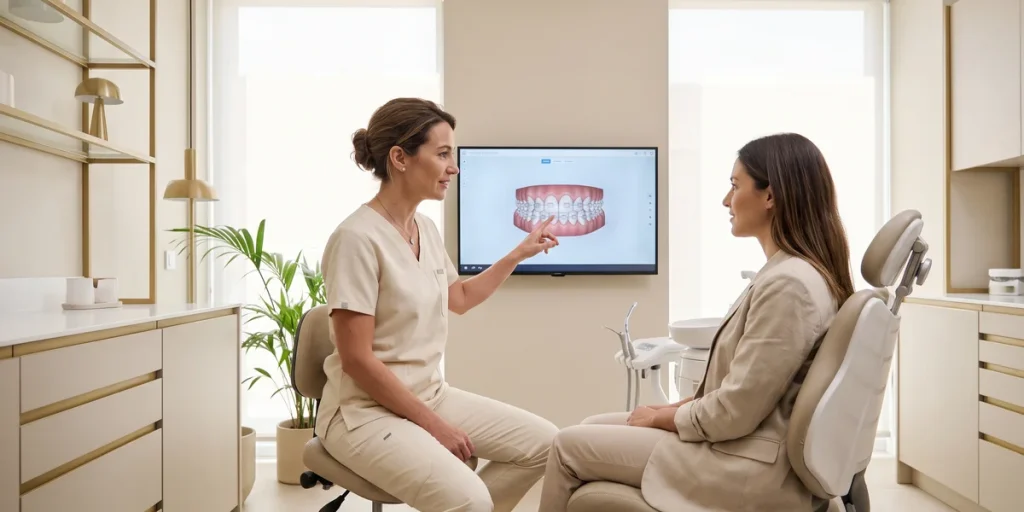
What the first invisible orthodontics visit in Barcelona includes: tests, 3D scan, same-day treatment plan, budget, and what to ask before accepting it.

Invisalign Comprehensive in Barcelona: what complex cases it corrects, when it's not enough, how long it lasts, what unlimited aligners mean, and what the price should include.
THE CLINIC IS CLOSED IN AUGUST.
You can schedule your first visit online now and secure your spot for a free full diagnosis in September.