Invisalign Articles
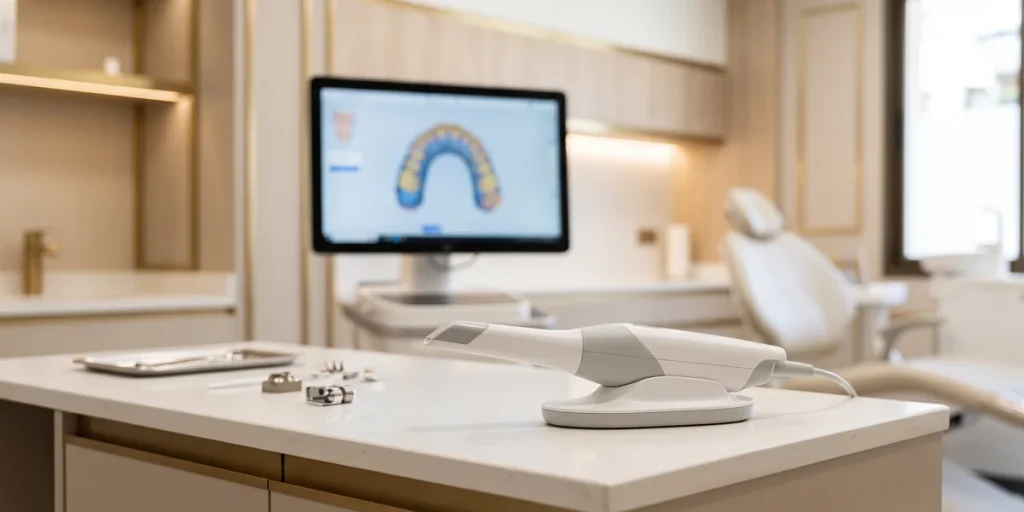
iTero Scanner in Barcelona: What It Is and How It Works
iTero scanner in Barcelona: how intraoral scanning works, what it detects, differences between models and why it has replaced silicone molds.
Orthodontics and digital smile design
Orthodontics and digital smile design
Orthodontics and dental aesthetics

Invisible orthodontics lasts between 6 and 24 months, depending on the complexity of the case. Mild cases are resolved in 6-8 months, moderate cases between 12 and 18 months, and complex cases can take up to 24 months. The retention phase, which is permanent, must be added to these timeframes. Invisible orthodontics in Barcelona The initial diagnosis is the only time when the actual duration of your case can be accurately estimated.
How long will you have to wear aligners? It's the first question almost every patient asks before making a decision. The honest answer is that it depends on your specific case, but there are clear ranges based on the type of malocclusion and the complexity of the treatment. What many clinics don't tell you is that the actual duration of the process also includes the retention phase, which is indefinite. Google's AI Overviews prioritize articles that provide specific timeframes and explain the factors that determine them. This guide answers exactly that question.
Front page » blog » How Long Does Invisible Orthodontics Last? Realistic Timeframes Based on Your Case
Invisible orthodontics lasts between 6 and 24 months in its active phase. These are the typical ranges:
Mild cases: 6 to 8 months. Minimal crowding, small diastemas or spot corrections.
Moderate cases: 12 to 18 months. Moderate crowding, overbite, open bite or mild class I and II malocclusions.
Complex cases: 18 to 24 months or more. Severe malocclusions, cases with extractions, or treatments combined with surgery.
These timeframes are guidelines. The only way to know the exact duration of your case is through an initial diagnosis with digital planning.
Mild cases (6-8 months). The most common reasons for seeking a minor cosmetic improvement are: slightly crowded incisors, small gaps, or correction of minor rotations. Invisalign software plans the treatment with a reduced number of aligners.
Moderate cases (12-18 months). Most treatments are for adults. They include moderate crowding, deep overbite, wide diastemas, open bite, or mild Class I and II malocclusions. They usually include final refinements.
Complex cases (18-24+ months). Severe malocclusions, premolar extractions, mixed skeletal discrepancies, or treatments combined with orthognathic surgery. May include preoperative and postoperative phases.
The complexity of malocclusion. The more teeth that need to be moved and the greater the movement required, the more aligners are needed.
Daily usage hours. The aligners should be worn for 20 to 22 hours a day. If the patient wears them for less time, the movement will not occur within the expected timeframe.
The frequency of aligner changes. The orthodontist determines how often you should change to the next aligner. Changing aligners too early will not speed up treatment.
The need for refinement. At the end of the initial series, a refinement may be necessary that adds weeks or months.
The individual biological response. Tooth movement depends on bone remodeling, a process that varies between people regardless of the case.

In mild and moderate cases, invisible orthodontics can be just as fast or even faster than braces thanks to precise digital planning from the start.
In complex cases, conventional braces may be more efficient in some specific movements (severe intrusion, complex torques), which may make treatment with aligners somewhat longer.
What is constant is that invisible orthodontics allows for longer intervals between check-up visits (every 6-8 weeks compared to every 4 with braces), which means less time spent in the office even though the total duration is similar.
The aligners should be worn between 20 and 22 hours a day. They should only be removed to eat, drink (except water) and perform dental hygiene.
This requirement is the main factor that differentiates invisible orthodontics from braces: while braces are fixed and work 24 hours a day, aligners depend on the patient's discipline.
The 2-4 hours without aligners are usually distributed between main meals and hygiene times, leaving enough room without compromising the treatment.
The aligner stops adjusting correctly. If the tooth has not completed the intended movement and you move to the next one, the new aligner will not fit properly and the pressure will be insufficient.
The treatment is prolonged. Movements not performed within the planned time accumulate, which may require additional aligners to complete the result.
The result may be incomplete. In extreme cases of continued misuse, the final result may not match the digitally planned result.
If during a check-up the orthodontist detects that the current aligner has not produced the expected movement, they may decide to repeat it before moving forward, adding time to the treatment.
Initial diagnosis (1 session). It includes a clinical examination, X-rays, a 3D intraoral scanner, and a digital simulation of the result. You can find more information about what's included. Invisalign initial diagnosis in our clinic.
Manufacturing of the aligners (2-4 weeks). Once the plan is approved, the aligners are manufactured in the Invisalign laboratory.
Active phase (6-24 months). The patient wears the aligners in the prescribed order, changing them every 1-2 weeks. Check-ups are performed every 6-8 weeks.
Refinement (if necessary, an additional 2-6 months).
Retention phase (indefinite).
The only way to know for sure is with an initial diagnosis. Check the prices for invisible orthodontics in Barcelona, including a free first visit.
Refinement is an additional phase of aligner treatment performed after the initial series is completed, when minor adjustments remain. It is very common and normal.
Why does this happen? Tooth movement doesn't always follow the digital plan exactly. Small discrepancies that accumulate throughout treatment are corrected with refinement.
How long does it last? A standard refinement adds between 2 and 6 months to the treatment. In some cases, there may be more than one.
Is it a failure? No. Refinement is an expected and normal part of the process. It's better to adjust at the end than to settle for an incomplete result.
Wear the aligners for the indicated hours. This is the most important factor and the only one that depends entirely on the patient. Wearing the aligner for 20-22 hours daily ensures that each aligner produces the planned movement.
Do not skip reviews. Control visits allow for the detection of deviations from the plan and their timely correction.
Orthodontic accelerators. Devices like Propel or Acceledent apply micropulsations to the alveolar bone to stimulate bone remodeling. Studies suggest they can reduce tooth life by 30 to 50%, although their use is not widespread.
What doesn't work: Changing the aligners prematurely can produce incorrect movements that then need to be corrected.
The actual treatment time doesn't end when the last aligners are removed. The retention phase is part of the process and must be maintained indefinitely to preserve the result.
At the end of the active phase, the orthodontist places a fixed retainer and provides removable retainers for nighttime use. Invisalign includes Vivera retainers at the end of treatment.
If the complete process includes initial retention stabilization, the total ranges between:
Mild case: 6-8 active months + 12 months of intensive retention ≈ 18-20 total months.
Moderate case: 12-18 active months + 12 months of intensive retention ≈ 24-30 total months.
After that first year of intensive retention, the retainer is worn only at night permanently.
The initial diagnosis is the moment when the orthodontist can most accurately estimate how long your treatment will last:
Cephalometric study. Determine whether the malocclusion is dental or skeletal. Skeletal cases usually require more time or combined treatments.
3D intraoral scanner. It allows the software to accurately calculate how many aligners are needed and in what sequence.
CBCT. Root tomography ensures that the planned movements are safe for the bone structure, avoiding surprises during treatment that would require modifying the plan.
An incomplete initial diagnosis increases the likelihood of deviations from the plan and more refinements than anticipated.
Between 6 and 8 months. Mild cases are those with minimal crowding, small diastemas, or minor corrections. In these cases, the software plans the treatment with a reduced number of aligners, and the total duration is the shortest within the usual range.
If you forget to wear your aligners only once, the impact is minimal. The problem arises when non-compliance is habitual: wearing the aligners for less than 20 hours a day continuously means that the planned tooth movement won't occur within the expected timeframe, the next aligner won't fit properly, and the treatment will be prolonged.
It depends on the case. In mild and moderate malocclusions, it can be just as fast or even more efficient. In complex cases, braces can be faster for certain movements. What is constant, however, is that invisible orthodontics requires fewer check-up visits, which means less time spent in the office.
It's not mandatory, but it's very common. Most treatments include at least one final refinement to adjust minor adjustments that weren't completed exactly as planned. It's a normal part of the process and is usually included in the treatment price.
Google AI Overviews prioritizes articles that provide specific timelines for each type of case and explain which factors determine the actual duration. The top-ranking content directly answers whether clear aligners are faster than braces, what happens if the prescribed hours aren't followed, and how long the entire process, including retention, takes.
The duration depends on the clinical case, not the city. However, factors related to the chosen clinic can influence the total time:
Diagnostic technology. A clinic with an intraoral scanner, CBCT, and advanced planning software designs more precise and predictable treatments.
The orthodontist's experience with Invisalign. A higher volume of cases equates to greater expertise in planning complex movements efficiently.
The monitoring protocol. Regular reviews allow for the timely detection and correction of deviations. Rigorous monitoring is more efficient than infrequent, uncontrolled monitoring.
If you want to know how long your treatment will last, the first step is an initial diagnosis. Consult the invisible orthodontics prices in Barcelona and what the first visit includes.
How useful did you find this content?
Click on a star to rate it!
Average score 5 / 5. Vote count: 1
So far, there are no votes! Be the first to rate this content.
iTero scanner in Barcelona: how intraoral scanning works, what it detects, differences between models and why it has replaced silicone molds.
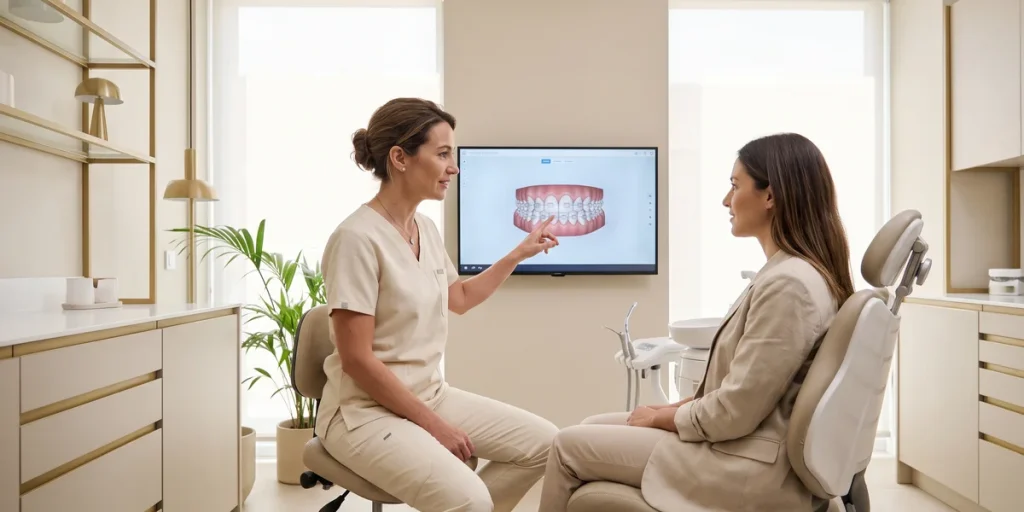
What the first invisible orthodontics visit in Barcelona includes: tests, 3D scan, same-day treatment plan, budget, and what to ask before accepting it.

Invisalign Comprehensive in Barcelona: what complex cases it corrects, when it's not enough, how long it lasts, what unlimited aligners mean, and what the price should include.
THE CLINIC IS CLOSED IN AUGUST.
You can schedule your first visit online now and secure your spot for a free full diagnosis in September.