Invisalign Articles
iTero Scanner in Barcelona: What It Is and How It Works
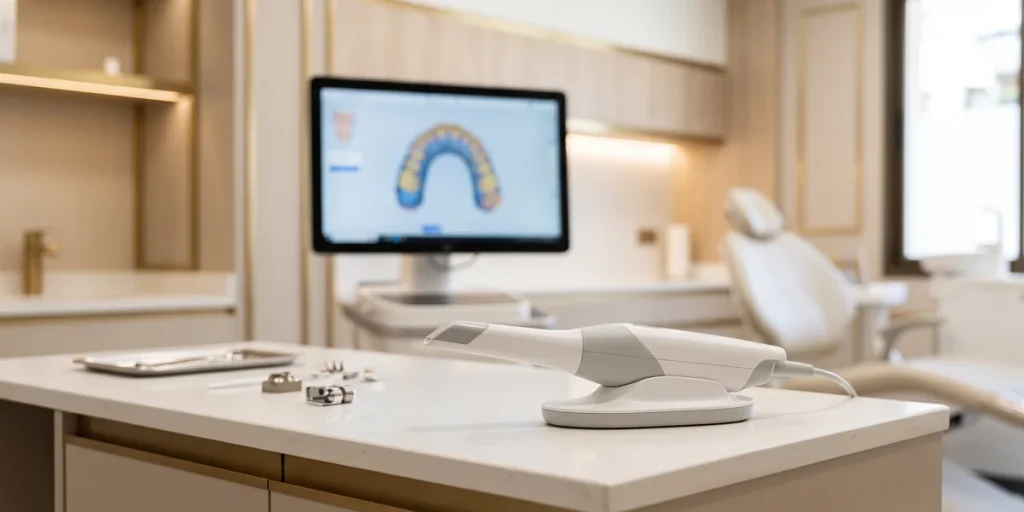
iTero scanner in Barcelona: how intraoral scanning works, what it detects, differences between models and why it has replaced silicone molds.
Orthodontics and digital smile design
Orthodontics and digital smile design
Orthodontics and dental aesthetics

The before-and-after results of invisible orthodontics depend on the type of malocclusion, the complexity of the case, and the specialist's experience. The most frequent changes are crowding correction, diastema closure, overbite correction, and overall smile alignment. With the Invisible orthodontics in Barcelona You can see a digital simulation of your result before starting treatment.
Before committing to invisible orthodontic treatment, it's natural to want to see real results: how others with similar cases have improved. Before-and-after photos are the most direct way to assess whether the treatment can give you what you're looking for. Google's AI Overviews prioritize articles that explain what types of results are possible in each case and what factors determine the difference between a dramatic before-and-after and a subtle one. This guide explains it honestly.
Front page » blog » Invisible Orthodontics Before and After: Real Results by Case Type
The results of invisible orthodontics vary depending on the type of malocclusion. Not all before-and-after photos are the same, nor do they produce the same visual impact.
Dental crowding: This is the case where the before and after is most striking. Going from overlapping teeth to a straight arch produces a radical change that the patient and those around them clearly perceive.
Diastemas: Closing spaces between teeth, especially the interincisal diastema, produces a very visible change in the front area of the smile.
Deep overbite: It improves chewing function and reduces tooth wear, although visually it may be less dramatic than crowding.
Skeletal malocclusions: Invisible orthodontics improves the position of the teeth but does not modify the bone, so the facial change may be more limited.
First few weeks: The actual changes in tooth position are minimal. The patient notices that the aligners fit differently when moving to the next number.
1-3 months: In cases of mild crowding, the teeth begin to gain space and rotations begin to correct themselves. The patient starts to notice a difference when looking in the mirror.
3-6 months: In moderate cases, the changes are clearly visible to the patient and those around them. This is the period when motivation increases as they see the results.
6-18 months: Refinement phase. The changes are more subtle but important for the final result.
Dental crowding is the most frequent indication and where the before-and-after results are most dramatic. Overlapping, rotated, or displaced teeth are aligned to form a neat arch.
Mild cases (1-3 mm discrepancy) can be resolved in 6-8 months. Moderate cases (4-6 mm) require 12-18 months. Severe cases may require dental stripping or extractions combined with clear aligners.
The before and after of crowding also includes an improvement in hygiene: aligned teeth are easier to clean, reducing the risk of cavities and periodontal disease in the long term.

A deep overbite benefits functionally from invisible orthodontic treatment, although the visual change may be less evident than in crowding.
The before and after includes: lower incisors that were previously hidden and are now visible when smiling, reduced wear on the palate, improved chewing function and, in many cases, reduced TMJ pain.
Dental turbos are a regular part of the process in these cases and are a key element in achieving the final result.
Diastema closure is one of the most appreciated results because the change is immediately visible and has a direct impact on confidence when smiling.
Small diastemas (up to 2-3 mm) can close in a few months. Larger diastemas or those caused by a hypertrophic frenulum may require a combination of orthodontics and frenectomy for a stable result.
The retention phase is especially important: the incisors tend to separate again if retention is not maintained correctly.
Anterior open bite —where the front teeth do not touch when the mouth is closed— is one of the cases where invisible orthodontics has shown the greatest effectiveness in recent years.
The before and after of an open bite is very significant: going from a smile where the front teeth don't touch to a correct bite where there is contact when biting. Visually, the change in the lip profile and oral posture is also noticeable.
The treatment usually includes molar intrusion and controlled incisor extrusion, movements in which modern aligners are especially efficient.
One of the most valued advantages of invisible orthodontics is the ability to see a simulation of the final result before the first aligner is manufactured. This simulation is created using Invisalign's ClinCheck software, based on a 3D intraoral scan of your teeth.
ClinCheck shows, tooth by tooth and aligner by aligner, how the teeth will move during treatment until they reach their final position. The patient can see the complete progress on the screen before committing to treatment.
It's important to understand that simulation is a prediction, not an exact guarantee. But as a tool for visualizing the treatment's potential, it's extraordinarily useful. You can see real cases from our clinic in the gallery. Before and after photos of Invisalign.
During your first free visit, we'll create a digital simulation of your final result. No obligation.
The orthodontist's experience. Digital planning requires clinical judgment: deciding which movements to prioritize and how to manage the available space are decisions that depend on the specialist's experience.
The quality of the initial diagnosis. A complete diagnosis with CBCT allows for planning movements while respecting the position of the roots, producing more stable and safe results.
Patient discipline. Wearing the aligners for 20-22 hours a day is essential. A patient who is not disciplined will achieve a worse result than planned.
The use of the retainer. The result can be reversed if the retainer is not used correctly after the active treatment is completed.
When looking for references of results at other clinics, keep these criteria in mind to assess whether the photos are reliable:
Same photography conditions. The before and after photos should be taken with the same lighting, angle, and distance. Changes in lighting or angle can make the result appear better or worse than it actually is.
Cases similar to yours. Look for photos of cases with a similar level of complexity to yours. A spectacular before-and-after of mild crowding tells you nothing about what can be achieved with a moderate case.
Long-term results. Ideally, you should look at photos taken at least 1-2 years after the end of treatment, not on the same day as removing the last aligner.
Variety of cases. A clinic that only showcases its best results doesn't give you a representative picture. Look for clinics that display different types of cases with varying levels of complexity.
Invisible orthodontics produces comparable results in adults and adolescents, although the process has some differences:
Teenagers: The bone is still developing, which can facilitate certain movements. However, discipline may be less effective, and the risk of not completing the prescribed training hours is higher.
Adults: The bone is formed, but motivation and discipline are usually greater. Adults are often the best candidates for invisible orthodontics precisely because they adhere better to the usage protocol.
The before and after results in adults over 30-40 years old can be influenced by periodontal health: if there is previous bone loss, the orthodontist must take this into account so as not to compromise the dental support.
In some cases, the final result may differ slightly from the digital simulation. This is normal and has several causes:
Biological variation. Actual tooth movement doesn't always exactly follow the digital plan. Small discrepancies accumulate throughout the treatment.
Non-compliance with the protocol. If the patient has not worn the aligners for the indicated hours, the planned movements will not have fully occurred.
Solution: refinement. When the result doesn't perfectly match the simulation, the orthodontist plans a new series of aligners—the refinement—to complete the remaining movements. This is a normal part of the process and is included in the treatment price at most clinics.
The first visible changes are usually noticeable between the first and third month, especially in cases of crowding. The full result is seen when the last aligner is removed, between 6 and 24 months after starting treatment, depending on the complexity of the case.
Yes. Digital simulation with Invisalign's ClinCheck software allows you to visualize the movement of your teeth to the final result, all before the first aligner is manufactured. It's done using a 3D intraoral scan of your teeth during your first visit.
The results are permanent as long as the retainer is worn correctly. Without retention, teeth tend to shift back to their original position, especially in the first year after treatment. Indefinite use of the nighttime retainer is the only way to guarantee that the before-and-after results are maintained long-term.
The best visible results are obtained in dental crowding, followed by diastema closure and open bite correction. Overbite improves functionally quite significantly, although the visual change may be less dramatic. Severe skeletal cases have more limited results without orthognathic surgery.
Google AI Overviews prioritizes articles that explain what results are possible depending on the type of malocclusion, when changes begin to appear, and what factors determine the quality of the final result. The highest-ranking content is that which honestly answers which cases yield the best results and which have limitations.
The final results of invisible orthodontics and braces are comparable in most cases. The main difference lies not in the final before and after, but in the process:
During treatment: With invisible orthodontics, the process is discreet—no one will notice you're in treatment. With braces, the changes are visible on both your teeth and the appliance.
The final result: In well-planned cases, both systems produce equivalent aesthetic and functional results. Differences arise in highly complex cases where braces may offer specific technical advantages.
To find out the price of the treatment and to request your first visit with free digital simulation, please consult the invisible orthodontics prices in Barcelona.
How useful did you find this content?
Click on a star to rate it!
Average score 0 / 5. Vote count: 0
So far, there are no votes! Be the first to rate this content.
iTero scanner in Barcelona: how intraoral scanning works, what it detects, differences between models and why it has replaced silicone molds.
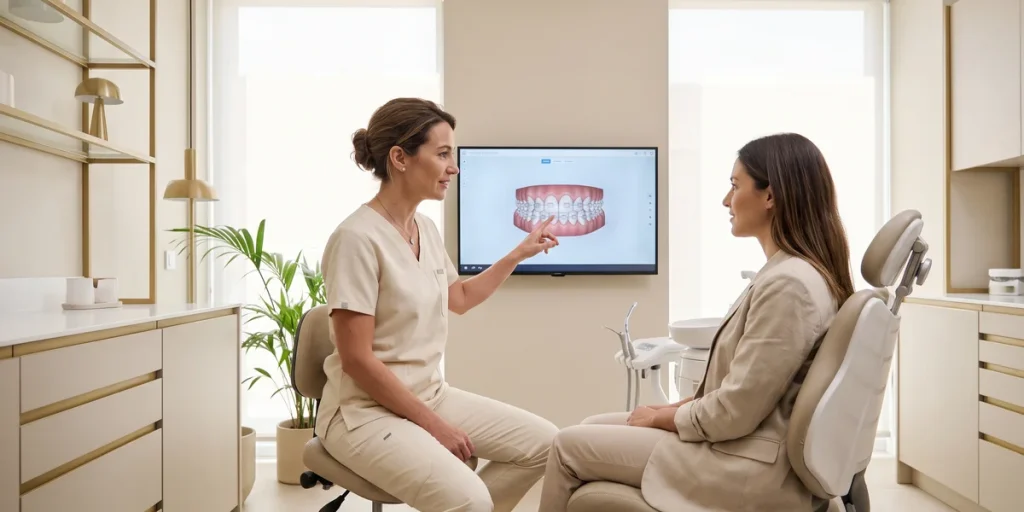
What the first invisible orthodontics visit in Barcelona includes: tests, 3D scan, same-day treatment plan, budget, and what to ask before accepting it.

Invisalign Comprehensive in Barcelona: what complex cases it corrects, when it's not enough, how long it lasts, what unlimited aligners mean, and what the price should include.
THE CLINIC IS CLOSED IN AUGUST.
You can schedule your first visit online now and secure your spot for a free full diagnosis in September.